

Starting a blog is exciting. However, one question stops most beginners dead in their tracks: how to choose a blog niche that actually works. They wonder how to choose a blog niche that actually works.
Pick the wrong topic, and you could spend months writing with zero traffic and no income. Pick the right niche and your blog can become a steady source of passive income.
Your blog niche is the foundation behind your blog. It shapes your audience, your SEO strategy, your content plan, and ultimately, how much money you can make.
You may wish to start a lifestyle blog, a tech site, or a personal finance platform. This guide breaks down exactly how to find your blog niche from scratch.
If you’re completely new to blogging, you may want to read our guide. It explains how to start a blog from scratch. Consider reviewing it before choosing a niche.
In this step-by-step guide, you’ll learn what a blogging niche is. You’ll find out why niche selection matters. You will also learn how to validate your idea and identify the most profitable niches currently available.
Understanding what a niche means is the first step. It helps in learning how to choose a blog niche that attracts the right audience.
Readers will learn:
- How to choose a profitable blog niche
- How to validate niche demand with SEO tools
- Examples of successful blog niches
- How beginners can avoid niche mistakes
Let’s get started.
What a Blog Niche Is in Blogging
Before selecting the right niche for your blog, it’s important to understand what a blog niche is and why it is significant at the beginning of your blogging journey. This section explains these concepts in straightforward terms.
What Does a Blog Niche Mean for a Blogger
A blog niche is a specific topic or subject area that your blog focuses on. Instead of writing about everything under the sun, you create content around one clearly defined theme.
These could include subjects such as budget travel, keto recipes, or AI tools for marketers.
Think of it like choosing a lane on a highway. The more specific your lane, the easier it is for readers to find you and trust you as an expert.
When I created my first blog, I made the classic mistake. I wrote about whatever I liked. It went nowhere. Niching down changed everything.
Why Niching Down Helps Blogs Grow Faster
When you focus on a niche within a niche, you’re not competing with every blog on the internet. You’re targeting a specific audience that has specific problems — and that makes your content far more valuable to them.
Google also rewards focused blogs. A blog that consistently covers a single topic builds topical authority more quickly than a general blog.
That means better SEO rankings. This leads to more organic traffic. It also results in a more loyal audience. These are all key ingredients for a profitable blog.
Examples of Popular Blogging Niches
| Blog Niche | Target Audience | Monetization |
|---|---|---|
| Personal Finance | Investors, savers | Affiliate programs, ads |
| Blogging & SEO | Bloggers | Courses, tools |
| Health & Fitness | Wellness readers | Coaching, supplements |
| Technology | Developers, marketers | SaaS affiliates |
| Food | Home cooks | Ads, brand deals |
| Education | Students | Courses, memberships |
Here are some examples of well-established blogging niches:
- Personal finance and investing
- Health, wellness, and fitness
- Travel and digital nomad lifestyle
- Technology, software, and AI tools
- Blogging, SEO, and online business
- Food, recipes, and nutrition
Blog Niche vs Micro Niche (What’s the Difference?)
When learning how to choose a blog niche, you’ll often hear the term micro niche. While both concepts are related, they represent different levels of focus in blogging.
A blog niche is a broad topic your blog is built around. It defines the general subject your blog posts will cover and the audience you want to reach.
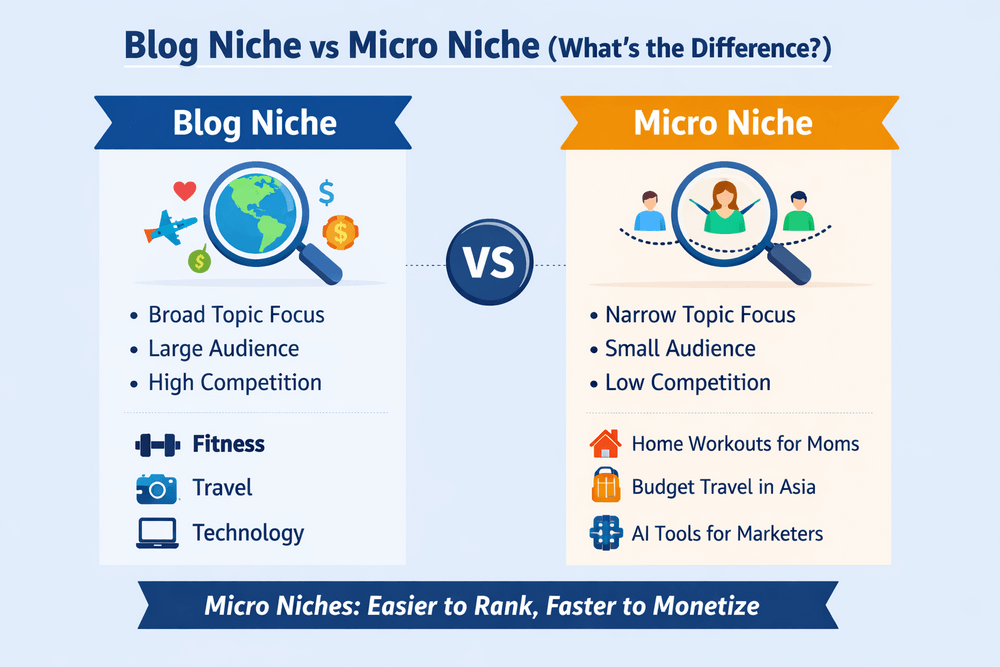
For example, a blog niche could be fitness, travel, technology, or personal finance. These niches attract large audiences, but they also come with higher competition.
A micro niche, on the other hand, is a much more specific segment within a broader niche.
Micro niches target a very specific audience with highly defined problems or interests. Because the topic is narrower, it’s usually easier for new bloggers to rank in search engines and build authority faster. Example
- Blog niche: Fitness
- Micro niche: Home workouts for busy moms
- Blog niche: Travel
- Micro niche: Budget travel in Southeast Asia
- Blog niche: Technology
- Micro niche: AI tools for marketers
Starting with a micro niche is often the smartest strategy when launching a new blog. You avoid competing with thousands of established blogs in a broad niche. Instead, you focus on a smaller audience that is actively searching for specific solutions.
As your blog grows and gains traffic, it develops authority. You will also cultivate a loyal audience.
You can gradually expand into related topics within the broader niche. This approach helps you establish SEO authority, attract targeted readers, and lay a solid foundation for a profitable blog.
Why Choosing the Right Blog Niche Is Important
Not all niches are created equal. The niche you choose will directly impact your traffic, your ability to earn money, and how quickly your blog grows.
Here’s why getting this decision right matters more than most beginners realize.
How a Good Niche Helps You Attract Readers
Readers don’t just want good content — they want content that speaks directly to their situation.
When your blog niche is clearly defined, visitors immediately know whether your blog is for them. This specificity builds trust, increases time on page, and boosts return visits.
A good niche also gives you a clear target audience. You know who you’re writing for, what problems they have, and what solutions they’re searching for.
That makes every blog post more purposeful and effective.
How Blog Niches Influence SEO and Traffic
From an SEO perspective, a focused niche is a major advantage. When all your blog posts cluster around a central topic, search engines gain a clear understanding of your site’s content. They rank it more confidently for relevant keywords.
Niche blogs tend to attract highly targeted backlinks, which boost domain authority.
They also have lower bounce rates because readers are more engaged. If you want real money from your blog, strong SEO is essential. Your niche is the starting point.
How the Right Niche Helps Bloggers Make Money
Different niches have vastly different monetization potential. Some niches attract high-paying affiliate programs.
Others are perfect for display ads via platforms like Mediavine or AdThrive. And some niches are ideal for selling courses, memberships, or consulting services.
Choosing a niche with clear monetization paths is crucial. It includes affiliate marketing, sponsored content, and digital products.
This is one of the smartest decisions you can make before you write a single blog post.
Key Factors to Consider Before You Choose a Niche
Picking a niche on a whim is one of the biggest mistakes new bloggers make. There are four core factors you should evaluate before committing to any topic. Skipping even one of them can cost you months of wasted effort.
Before deciding how to choose a blog niche, it’s important to evaluate a few critical factors that determine long-term success.
1. Personal Interest and Long-Term Passion
Blogging is a long game. You’ll spend years creating content, so you’d like the topic to be something you genuinely enjoy. If you’re only blogging for money, you’ll burn out the moment results are slow.
A hobby or area of expertise you’re passionate about is a huge asset. Your enthusiasm comes through in your writing, and you write with passion — people can feel it. Readers connect with authentic voices, which helps grow a loyal audience faster.
2. Market Demand and People Are Interested
Passion alone isn’t enough. People must be actively searching for content in your niche. You want to validate that there’s genuine demand — meaning real readers spending time and money learning about your topic.
Use tools like Google Trends, Answer the Public, or keyword tools to check search volume. If you’re interested in a topic but find that nobody is searching for it, take it as a sign. It might not be the best choice for a new blog.
3. Competition in the Blog Niche
Some niches are extremely competitive, like weight loss or personal finance. That doesn’t mean you should avoid them — but you need a strategy. Focus on a sub-niche or bring a unique angle that larger blogs haven’t covered.
Look for low competition blog niches with decent search volume. These are the hidden gems where a beginner blogger can make real headway in under a year.
4. Monetization Opportunities
Before committing to a niche, ask yourself: how will I monetize this blog? The best niches for bloggers offer multiple revenue streams. These include affiliate marketing commissions, ad revenue, and sponsored posts. They can also involve digital downloads or online courses.
Research affiliate programs in your niche. Check if brands spend money advertising in it. See if courses or products exist. If people are already making money in the space, that’s a green flag.
The 3-Factor Blog Niche Formula
A successful blog niche usually sits at the intersection of:
- Your passion – topics you enjoy writing about
- Market demand – subjects people are actively searching for
- Monetization potential – opportunities to earn through ads, affiliate marketing, or products
When all three overlap, you have a strong niche foundation.
How to Choose a Blog Niche (Step-by-Step Guide)
If you’re wondering how to choose a blog niche, follow the step-by-step process below. It will guide you in making the right decision.
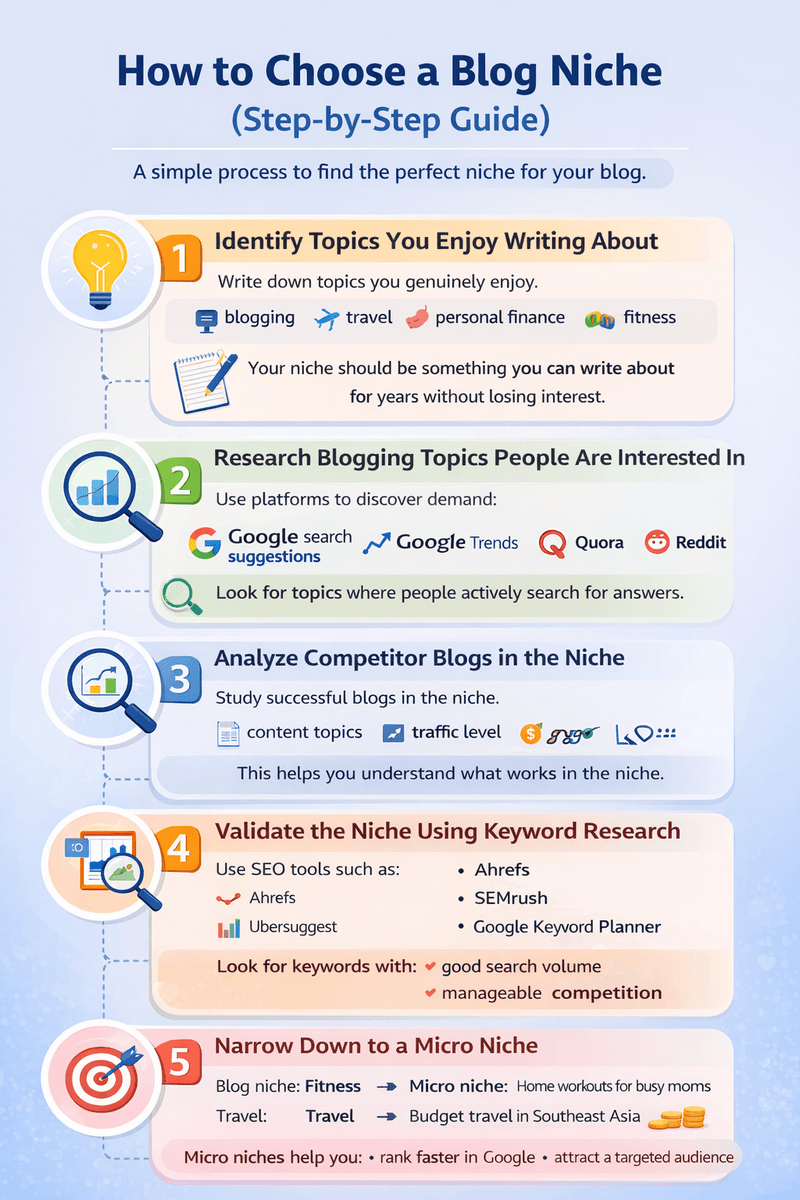
Ready to find your perfect blog niche? Follow these five steps in order.
Each step builds on the previous one. By the time you reach step five, you’ll have a niche that’s validated. It will be focused and ready to grow.
Step 1: Identify Topics You Enjoy Writing About for Your Blog
Start with a brain dump. Write a list of things you’re knowledgeable about, interested in, or could talk about for hours.
Don’t filter yourself yet — brainstorm freely. Include hobbies, professional skills, past experiences, and subjects you love learning about.
The goal here is to create a long list of things you’d like to write about. Quantity matters at this stage. You’ll narrow it down later.
Step 2: Research Blogging Topics People Are Interested In
Now cross-reference your list with what people are actually searching for. Browse Reddit threads, Quora questions, and YouTube videos to see which topics get the most engagement.
Social platforms like TikTok and LinkedIn can also reveal trending content areas.
When you find a topic where your interest intersects with strong public demand — that’s your sweet spot. Learning about blogging from real community discussions is far more valuable than relying on guesswork.
Step 3: Analyze Competitor Blogs in the Niche
Google your top niche ideas and study the blogs that rank on page one.
Are they large media companies, or are there smaller, independent blogs that are doing well? If you find niche blog examples from solo creators with strong traffic, that’s a promising sign.
Evaluate their content quality, frequency of publication, and the range of topics they cover. Gaps in their content are opportunities for your blog.
Use this analysis to define what makes your voice and angle different.
Step 4: Validate the Niche Using Keyword Research
This is where blog niche keyword research becomes essential. Utilize tools such as Ahrefs, Semrush, or Google Keyword Planner. Check monthly search volumes for your niche’s core topics. Assess keyword difficulty as well.
Tools like Ahrefs and Semrush help validate keyword demand. You can also explore our guide on the best keyword research tools for bloggers.
You want to find keywords with decent volume and manageable competition — especially for a beginner.
Long-tail keywords are your best friends in the early stages. They are easier to rank for. They attract highly targeted visitors.
Step 5: Narrow Down to a Micro Niche
Once you’ve validated demand, consider going even further with specificity. Micro niche blogging means targeting a very narrow topic within a broader category.
For example, instead of blogging about fitness, you focus on home workouts for busy parents.
Micro niche blog ideas are often less competitive, easier to rank for, and quicker to build authority in.
As your blog grows, you can gradually expand your scope while maintaining your core audience.
How to Find Low Competition Blog Niches (With Examples)
Identifying a low competition niche for your new blog is crucial. This can dramatically increase your chances of ranking in search engines.
It also helps in growing your audience faster. Instead of competing with thousands of established blogs on broad topics, focus on a narrower niche.
This focus helps you make your blog more visible to the right readers from the start.
The key is to identify topics that people are actively searching for. Large authority websites should not heavily dominate these topics.
Many experienced bloggers suggest looking for gaps in popular niches.
Advice often recommended from Medium and other blogging communities highlights the importance of combining audience demand with a unique perspective.
Here are several practical ways to discover low competition blog niches.
1. Find Specific Problems Within Broad Blog Niches
Broad niches, such as health, travel, or finance, are extremely competitive. Instead of targeting the entire niche, focus on solving one specific problem for a defined audience.
Example
- Broad niche: Fitness
- Low competition niche: Home workouts for busy parents
- Broad niche: Personal finance
- Low competition niche: Budgeting tips for freelancers
- Broad niche: Technology
- Low competition niche: AI tools for small business owners
By narrowing your focus, you create a niche. In this niche, you can write with passion for people who share the same interests and challenges.
2. Use Question Platforms to Discover Niche Content Gaps
Platforms like Quora, Reddit, and niche forums are excellent places to discover what people are asking. They often lack detailed answers. When a question has many views but very few high-quality answers, it often signals a low-competition content opportunity.
For example:
- “How can beginners start investing with small amounts?”
- “What are the best productivity tools for remote workers?”
Each of these questions can serve as the foundation for a niche blog or a content category.
3. Analyze Keyword Difficulty to Find Low Competition Niches
SEO tools such as Ahrefs, Semrush, or Ubersuggest can help you identify keywords with lower competition. Look for search terms with moderate search volume but lower keyword difficulty scores.
Examples of low competition keyword-based niches might include:
- Budget travel for digital nomads
- Healthy meal prep for college students
- AI tools for content creators
These topics still have demand but are less crowded compared to broader niches.
Learning how to choose a blog niche with lower competition can greatly enhance your chances. This improvement helps you rank faster in search engines.
4. Combine Interests to Create a Unique Blog Niche
Another effective strategy is to combine two interests into a single niche. This creates a unique angle that fewer bloggers are targeting.
Examples:
- Travel + remote work → Travel tips for remote workers
- Fitness + productivity → Morning fitness routines for entrepreneurs
- Technology + education → AI tools for students
This approach helps you stand out while building a niche where you can consistently create helpful content.
5. Test Blog Niche Ideas Before Fully Committing
Before fully committing to a niche, try publishing a few test articles or researching search trends. If the topic consistently shows demand and engagement, it may be a strong long-term niche.
When you find a niche that matches your interest and audience demand, you lay a solid foundation.
Manageable competition will further enhance the growth of a successful blog. Over time, focusing on these targeted topics will help make your blog more authoritative and attract a loyal audience.
How to Find a Unique Angle and Stand Out in a Competitive Blog Niche
Entering a competitive blog niche doesn’t mean you can’t succeed. Many successful bloggers grow their audience by approaching a common topic from a unique perspective.
Avoid competing with large blogs on the same content. Instead, concentrate on creating a clear angle. This makes your blog different.
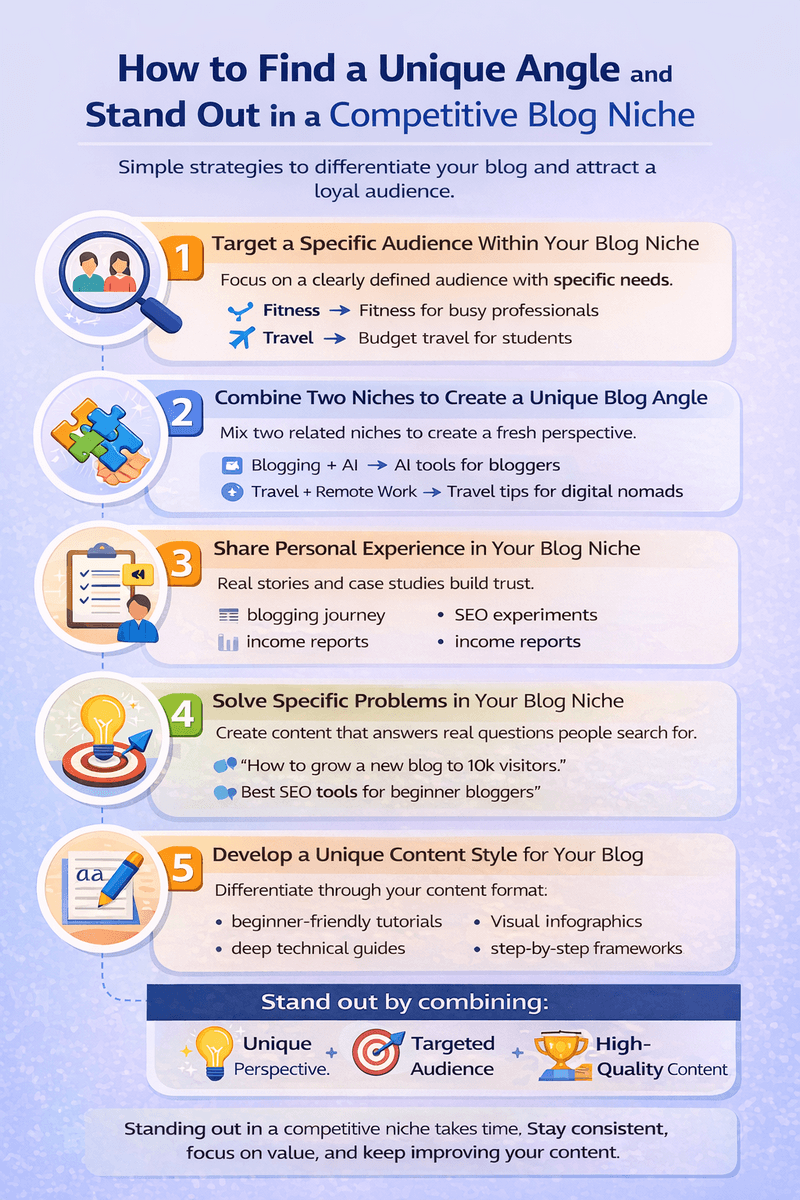
Here are several ways to stand out in a crowded blogging niche.
1. Target a Specific Audience Within Your Blog Niche
One of the easiest ways to differentiate your blog is by narrowing your audience. Instead of writing for everyone, focus on a group with specific needs.
Example
- Broad topic: Fitness
- Unique angle: Fitness tips for busy entrepreneurs
- Broad topic: Travel
- Unique angle: Budget travel for solo female travelers
By targeting a specific audience, you create content that feels more personal and relevant.
2. Combine Two Niches to Create a Unique Blog Angle
Another effective strategy is combining two related interests to form a unique niche.
Examples
- Blogging + AI → AI tools for bloggers
- Fitness + productivity → Morning fitness routines for entrepreneurs
- Travel + remote work → Travel guides for digital nomads
This combination creates a distinctive position that fewer blogs are targeting.
3. Share Personal Experience in Your Blog Niche
Readers connect strongly with real experiences. Sharing your personal blogging journey, results, experiments, and case studies can instantly make your content more valuable and engaging.
For example:
- income reports
- blogging experiments
- real SEO growth case studies
This type of content builds credibility and trust.
4. Solve Specific Problems in Your Blog Niche
Many blogs cover general topics, but the most successful blogs focus on solving clear problems for their readers.
- Instead of writing broad posts like: “Tips for Blogging.”
- Create problem-focused content such as: “How to Grow a New Blog to 10,000 Visitors.”
Problem-focused content attracts highly targeted readers.
5. Develop a Unique Content Style for Your Blog
Your writing style can also help you stand out. Some blogs succeed because they provide:
- simple beginner tutorials
- deep technical guides
- step-by-step frameworks
- visual guides and case studies
Consistency in tone and style helps build a recognizable brand.
6. Create Better Content Than Competing Blogs
Sometimes the best way to stand out is to produce more helpful and comprehensive content.
Ways to improve content quality include:
- deeper research
- clearer explanations
- visual examples
- step-by-step tutorials
When your content becomes the best resource on a topic, readers and search engines naturally reward it.
List of the Most Profitable Blog Niches in 2026
Selecting a profitable niche can substantially enhance your chances of generating income from your blog. While many niches attract readers, only a select few offer strong monetization opportunities through affiliate marketing, ads, and digital products.
Here are some of the most profitable blog niches in 2026.
1. Personal Finance
Personal finance remains one of the most profitable blogging niches. Readers actively search for ways to save money, invest wisely, reduce debt, and achieve financial independence.
Monetization opportunities include:
- affiliate partnerships with financial tools
- credit card and investment platforms
- online finance courses
2. Blogging and Online Business
Blogs that teach blogging, SEO, and online business strategies attract entrepreneurs and marketers who want to build online income streams.
Popular monetization options include:
- hosting affiliate programs
- SEO and marketing tools
- blogging courses, and coaching
3. Health and Fitness
Health-related blogs consistently attract large audiences. People search daily for solutions related to weight loss, nutrition, workouts, and mental wellness.
Revenue opportunities include:
- fitness programs
- health products
- coaching services
4. Technology and AI
Technology blogs covering software tools, AI platforms, and digital solutions have a massive demand in today’s digital economy.
These blogs often earn through:
- SaaS affiliate programs
- product reviews and comparisons
- online tech tutorials
5. Digital Marketing
Digital marketing blogs focus on SEO, content marketing, social media marketing, and advertising strategies.
These blogs monetize through:
- marketing tool affiliates
- consulting services
- online courses and workshops
6. Make Money Online
This niche focuses on side hustles, freelancing, passive income, and remote work opportunities. It attracts a large audience seeking practical ways to earn money online.
Common monetization sources include:
- affiliate marketing platforms
- digital products and guides
- membership communities
7. Education and Skill Development
Education blogs covering online learning, coding, career development, and professional skills are growing rapidly.
These blogs generate income through:
- online course affiliates
- learning platforms
- premium tutorials and guides
8. Food and Recipes
Food blogs remain highly profitable when combined with strong SEO and social media traffic.
Monetization methods include:
- display ads
- sponsored brand partnerships
- cookbooks and recipe memberships
How to Validate Your Blog Niche Idea
Having a niche idea is great — but acting on it without validation is risky. These three methods will help you confirm there’s genuine demand for your chosen topic.
Ensure this before investing time and energy in building your blog.
1. Use Google Trends to Validate Blog Niche Popularity
Google Trends is a free tool that shows you how interest in a topic has changed over time. Search for your niche idea and look at the trend line.
Is it rising, stable, or declining? You want a topic that’s consistently popular or trending upward — not one that peaked three years ago.
You can also compare multiple niche ideas side by side to see which has stronger long-term demand. This is one of the quickest ways to do niche research for blogging without spending a cent.
2. Check Blog Niche Keyword Demand with SEO Tools
Use an SEO tool to check keyword demand. Look for core keywords in your niche and analyze monthly search volume, competition scores, and related terms.
A niche blog SEO strategy starts here. Understanding what your audience types into Google determines the content you should create.
If you find dozens of related keywords with meaningful volume, that’s a sign the niche has enough content potential. This potential can sustain a blog in the long term.
3. Analyze Audience Problems to Validate Your Niche
Head to platforms like Quora, Reddit, or even Facebook groups to see what questions your target audience is asking. These real conversations reveal genuine pain points that your blog can address.
You can run a quick survey among people in your target audience. Alternatively, browse case studies from established blogs in your niche. The more you understand your audience’s problems, the better equipped you are to build a niche authority blog.
Tools That Help Bloggers Choose a Niche
You don’t have to rely on guesswork when choosing your niche. These tools provide real data on search demand. They also offer insights on content trends and audience behavior. This makes the entire niche selection process faster and more accurate.
1. Keyword Research Tools
These tools are essential for any beginner blogger:
- Ahrefs — comprehensive keyword data, competitor analysis, and backlink insights
- Semrush — excellent for niche research for blogging and tracking keyword trends
- Google Keyword Planner — a free tool for checking search volume and ad competition
- Ubersuggest — a beginner-friendly tool with good keyword suggestions
2. Content Research Platforms
- BuzzSumo — shows top-performing content in any niche
- Answer the Public — great for finding questions your audience is asking
- Exploding Topics — identifies emerging niche trends before they peak
3. Audience Research Tools
- SparkToro — reveals where your target audience hangs out online
- Reddit & Quora — free and incredibly insightful for blog audience targeting
- Google Trends — perfect for checking niche blog demand over time
Common Mistakes Bloggers Make When Choosing a Niche
Knowing what not to do is just as valuable as knowing what to do. These are the four most common mistakes in niche selection.
These mistakes cause new bloggers to struggle. Learn how to avoid making them yourself.
1. Choosing a Niche Only for Money
Many beginners make the mistake of choosing a topic purely for its earning potential. While profitability matters, writing without genuine interest is unsustainable.
You’ll struggle to produce consistent, high-quality content — and readers will sense the lack of authenticity.
2. Selecting a Topic That Is Too Broad
Choosing a topic like ‘health’ or ‘technology’ is far too broad. You’ll be competing with billion-dollar media companies from day one.
Narrow blog niche ideas are more manageable and allow you to build authority more quickly.
3. Ignoring Audience Demand
Some bloggers fall in love with a topic without checking whether anyone else is interested in learning about it.
No demand equals no traffic, no readers, and no income. Always validate audience demand with data — not assumptions.
4. Not Checking Competition
Going into a hyper-competitive niche without a strategy is a recipe for frustration. If established authority sites dominate the top results, you need either a micro niche angle.
Alternatively, you need a unique positioning that separates you from the pack.
Tips to Choose a Profitable Blogging Niche
Choosing a profitable niche isn’t just about picking a hot topic — it’s about building something sustainable.
Keep these four principles in mind, and you’ll set your blog up for long-term success from day one.
1. Focus on Solving Real Problems
The most successful blogs don’t just share information — they help you find solutions to specific problems.
When you’re choosing a blogging niche, ask yourself two questions. What struggles does this audience face? How can my content help them?
2. Choose a Topic You Can Write About for Years
Your blog niche needs longevity. Choose a topic you can see yourself creating content around for years — not just months.
Consider whether the niche has sufficient subtopics, angles, and evolving trends to sustain a long-term content niche strategy.
3. Consider Affiliate and Product Opportunities
Some of the best niches for affiliate marketing blogs have generous commissions and a wide range of products to promote.
Research whether brands in your niche actively work with bloggers. Check if there are recurring commission programs. Look for digital products or software tools to recommend.
4. Build Authority in One Specific Topic
Resist the temptation to cover too many topics. Niche authority blogging is about becoming the go-to resource for one specific subject.
When Google sees you as a trusted expert in your niche, everything else follows naturally. Readers also recognize you as an authority. This recognition leads to increased traffic, links, and income.
Future Trends in Blogging Niches
The blogging landscape is always evolving. Staying ahead of emerging trends means you can position your blog in a growing space before it becomes oversaturated.
These three niches are currently showing strong momentum and are expected to continue this trend into the coming years.
1. AI and Automation Topics
AI is one of the most explosive trending blog niches right now. From AI writing tools to automation software for businesses, there’s an enormous appetite for tutorials, comparisons, and guides. This niche is growing fast and showing no signs of slowing down.
2. Creator Economy and Personal Branding
More people are building businesses around their personal brand, such as coaches, content creators, or consultants.
A blog that teaches people how to monetize their skills is in high demand. It also shows how to grow on platforms like TikTok or LinkedIn. Additionally, it helps launch a creator career.
3. Digital Skills and Online Learning
Demand for digital skills education is surging. Blogs that cover coding, data analysis, UX design, video editing, or online marketing are attracting highly engaged audiences.
These audiences are actively seeking career advice. They also want skill development content.
4. AI Automation for Small Businesses
Businesses are increasingly relying on automation tools for marketing, content creation, and analytics. Blogs that review and explain AI automation platforms have strong traffic potential.
Blog Niche Examples That Became Successful Blogs
Examining real-world examples can help you understand the power of a well-chosen blog niche.
Many highly successful blogs started by focusing on a specific niche and consistently creating valuable content for a targeted audience.
Over time, these blogs built authority, attracted large audiences, and developed strong monetization strategies.
Here are a few well-known examples of blogs that grew by focusing on a clear niche.
1. NerdWallet → Personal Finance Niche

NerdWallet is one of the most successful websites in the personal finance niche. The blog aims to help readers make informed financial decisions by providing guides on credit cards, loans, insurance, and investing.
The site targets practical financial questions that people search for every day. It attracts massive SEO traffic. The site monetizes through financial product partnerships and affiliate programs.
2. Smart Passive Income → Blogging and Online Business

Smart Passive Income, created by Pat Flynn, is a well-known blog in the blogging and online business niche.
The blog teaches readers how to build online businesses, grow blogs, create digital products, and generate passive income.
Its success comes from transparent case studies, tutorials, podcasts, and courses that help entrepreneurs build sustainable online income streams.
3. Pinch of Yum → Food Blogging Niche

Pinch of Yum is a highly successful blog in the food blogging niche. The site focuses on recipes, cooking tutorials, and food photography.
The blog created visually appealing recipes and shared helpful cooking tips. Through SEO and social platforms like Pinterest, it built a massive audience.
It generates income through display ads, sponsored content, and digital products.
These examples demonstrate that successful blogs typically begin with a clear niche, consistent content creation, and a strong focus on their audience.
Providing valuable information increases your blog’s chance of success. Coupling this with a well-defined topic helps grow your blog into a recognizable and profitable brand.
Blog Niche Selection Checklist
Before choosing your niche, ask:
- Do I enjoy this topic?
- Are people searching for it?
- Can I monetize it?
- Is competition manageable?
- Can I write 50+ posts about it?
FAQs About Choosing a Blog Niche
Still have questions? You’re not alone. Here are the most common questions beginners ask when selecting their blog niche. We provide clear, practical answers to help you move forward with confidence.
How do I choose a blog niche if I have multiple interests?
If you’re unsure how to choose a blog niche, start by identifying the topic that has both strong search demand and monetization potential. Start with one focused niche — you can always expand later as your blog grows and your audience becomes clearer.
What is the most profitable blog niche for beginners?
Some of the most profitable niches for beginner bloggers include personal finance, digital marketing, health and wellness, and technology. These niches feature strong affiliate programs, high ad RPMs, and large audiences actively seeking content and solutions.
How do I find a profitable blog niche with low competition?
Utilize SEO tools like Ahrefs or Ubersuggest to search for keywords with a decent monthly volume and low difficulty scores. Browse Quora and Reddit to identify topics with numerous questions but few detailed answers. These are signs of an underserved niche with real growth potential.
Should I choose a broad niche or a niche that’s more specific for a new blog?
For a new blog, a micro niche is almost always the better starting point. It’s less competitive, easier to rank in, and helps you build authority faster. As your blog gains traction, traffic, and backlinks, you can gradually broaden your scope while keeping your loyal core audience.
How long does it take to make money from a niche blog?
Most niche blogs take 6 to 18 months to generate meaningful income. The timeline depends on your niche competition, content quality, publishing frequency, and SEO efforts. Blogs in high-paying niches with strong affiliate programs can start generating passive income more quickly when content is consistent and targeted.
Can I change my blog niche after I start?
Yes, you can pivot your blog niche, but it comes with risks — especially around SEO authority and audience expectations. The best approach is to gradually shift your content focus rather than doing a hard rebrand. Starting with a well-researched niche from the outset reduces the likelihood that you’ll need to change direction.
What niche should I blog about if I’m a complete beginner?
Start with what you know and love. The best niche for beginner bloggers is one where you have genuine knowledge or enthusiasm. It should have measurable audience demand. There should also be clear ways to earn money. Learning about blogging itself, personal finance basics, or a skill you already have are all excellent starting points.
Is niche blogging still profitable in 2026?
Yes, niche blogging remains highly profitable in 2026 when executed with the right strategy. A focused niche blog can attract consistent search engine traffic. It does this by targeting specific keywords and solving real problems for readers. This targeted traffic creates strong monetization opportunities. Bloggers recommend useful tools or products. They earn commissions through affiliate marketing. Many bloggers also generate income by selling digital products such as ebooks, courses, templates, or memberships. By combining SEO-driven content with effective monetization methods, niche blogs can continue to generate a reliable online income.
How narrow should a blog niche be?
A blog niche should be specific enough to target a clear audience. It should also be broad enough to support at least 50–100 blog post ideas. Many successful blogs begin with a micro-niche and gradually expand as their authority grows.
Final Thoughts on Choosing the Right Blog Niche
Choosing a blog niche is one of the most important decisions you’ll make when creating a blog. It sets the direction for your content, your audience, and your long-term success in blogging. When you choose a niche carefully, it becomes much easier to grow your blog. You can attract targeted readers more effectively. Over time, you will build a profitable blog.
The smartest way to approach this decision is to think step by step. First, explore topics you truly enjoy so you can write with passion that people will connect with. Next, research demand using SEO tools, keyword analysis, and audience platforms, so you know which niche has real interest. When passion meets market demand, your blog becomes easier to grow and monetize.
Now that your niche is validated, your next milestone is learning how to write content that ranks so you can start publishing targeted articles.
Many successful bloggers recommend starting with something you genuinely care about. Blogging communities, such as Medium, often advise on choosing a niche. This niche should blend your interests with audience demand. In other words, don’t just choose a popular topic. Instead, choose one where you can consistently create helpful blog posts and build authority.
It’s also important to consider the long-term opportunities your niche presents. A well-chosen niche can open doors to affiliate marketing, monetization, and other online revenue streams. When your niche solves real problems for readers, your blog grows naturally. It becomes a profitable way to earn passive income. You can also build a loyal audience.
At the same time, remember that your niche doesn’t have to be perfect from day one. Many bloggers refine their niche as they continue their blogging journey. The key is to start with a focused topic. You should publish consistently. Continuously improve by learning what topics resonate most with your audience.
The best blog niche is one that aligns with your interests. It should align with your knowledge. It also needs to resonate with what people are interested in. The right niche will maintain your motivation. It will also help your blog grow over time, whether it’s a hobby, a professional skill, or something you’re passionate about.
By following the strategies in this guide, you now understand. You know how to choose a blog niche that aligns with your interests. It also matches your long-term blogging goals.
So stop overthinking and take action. Once you decide your niche and publish your first post, your blogging journey truly begins. Stick with it, keep learning, and your new blog can evolve into something meaningful—and potentially very profitable. Happy blogging!
Discover more from DigiSatish
Subscribe to get the latest posts sent to your email.