
Blogging is the process of creating, publishing, and regularly updating useful content on a website, usually in the form of blog posts. In simple terms, blogging means sharing information, knowledge, experiences, opinions, or solutions online through a blog.
If you are searching for what is blogging for beginners, think of it as creating a website around a topic and publishing helpful content that people want to read. A blog can cover almost any subject, including technology, education, blogging, SEO, travel, food, finance, health, business, lifestyle, or personal experiences.
The blogging definition has evolved considerably since blogs first became popular. Early blogs were often used as online journals or personal diaries, while modern blogs are also used by individuals, businesses, educators, professionals, and content creators to share expertise, attract audiences, build personal brands, promote products and services, and generate income.
Understanding what does blogging mean today requires looking beyond simply writing articles. Successful blogging can involve researching topics, understanding what readers are searching for, creating useful content, optimizing articles for search engines, promoting published posts, building an audience, and updating older content.
In this beginner-friendly guide, you will learn what blogging is, what a blog is, what a blogger does, how blogging works, the different types of blogs, why people blog, how bloggers make money, and how to start your own blog.
Whether you are completely new to blogging or considering starting a website, this guide will give you a clear foundation before you move into the more detailed aspects of blogging.
What Is a Blogger?
A blogger is a person, group, or organization that creates and publishes content on a blog or website. Bloggers may write about their personal experiences, professional expertise, hobbies, interests, products, services, or specific topics for a particular audience.
A blogger does not necessarily have to be a professional writer. Anyone who regularly creates useful content for an audience can be a blogger.
Bloggers can include:
- Individuals: People who create blogs to share their experiences, opinions, knowledge, or interests.
- Professional writers: Writers who create blog content as part of their career or freelance work.
- Businesses: Companies that publish content to educate customers, attract potential buyers, and support their marketing efforts.
- Organizations: Nonprofits, educational institutions, communities, and other organizations that use blogs to communicate information.
- Subject-matter experts: Professionals who share specialized knowledge and experience with their audience.
- Content creators: Creators who combine blog posts with videos, podcasts, social media content, newsletters, and other formats.
Blogging can therefore take many forms. Someone might maintain a blog as a hobby, while another person may treat blogging as a profession. Businesses can use blogging as a marketing strategy, and entrepreneurs can build an online business around their blog.
The difference is usually not who the blogger is, but why they are publishing content and who they are creating it for.
What Does a Blogger Do?
A blogger’s work involves much more than simply writing an article. Creating a useful blog post typically involves research, planning, writing, optimization, publishing, promotion, and ongoing updates.
A typical blogging workflow looks like this:
- Research a Topic: A blogger starts by identifying a topic that is useful or interesting to the target audience. Research may involve studying existing information, identifying common questions, checking competitors, and finding reliable sources.
- Find Keywords and Search Intent: For blogs that depend on search traffic, bloggers research keywords people use in search engines. They also try to understand search intent, or what a person is actually looking for when they search for a particular phrase. For example, someone searching for “how to start a blog” is likely looking for practical instructions, while someone searching for “what is blogging” may initially want a simple explanation.
- Plan an Outline: Before writing, a blogger can create an outline that organizes the main points of the article. A good outline helps ensure that the content answers the reader’s questions without unnecessary repetition.
- Write the Article: The blogger then creates the main content. The writing should be clear, useful, accurate, and appropriate for the intended audience. Depending on the topic, a blog post might be a tutorial, guide, review, comparison, case study, list, or another type of content.
- Edit and Fact-Check: After writing, the blogger reviews the article for grammar, clarity, accuracy, formatting, and missing information. Important factual claims should be checked against reliable sources. Editing can also make the article easier to read and help remove unnecessary or repetitive information.
- Add Images and Media: Bloggers may add relevant images, screenshots, diagrams, videos, charts, or other media to make the content easier to understand. Visual elements can be particularly useful for tutorials, product reviews, technical guides, and educational articles.
- Optimize for Search Engines: Bloggers can apply basic SEO practices to help search engines understand and discover their content. This can include using relevant keywords naturally, creating descriptive headings, improving internal linking, writing useful title and meta description elements, and making the page easy to navigate. SEO should support the reader rather than making an article difficult or unnatural to read.
- Publish the Content: Once the article has been reviewed and formatted, the blogger publishes it on their blog or website. The post may then become accessible through search engines, social media, direct links, email newsletters, and other channels.
- Promote the Article: Publishing a post does not necessarily mean people will immediately find it. Bloggers may promote new content through social media, email newsletters, communities, partnerships, or other appropriate channels. The promotion method depends on the blog’s audience and overall content strategy.
- Update the Content: Good blogging is not always a one-time publishing process. Bloggers may revisit older articles to update outdated information, add new examples, improve sections, fix broken links, and make the content more useful. Regular updates can be particularly important for topics that change frequently, such as technology, software, SEO, online services, and industry news.
Overall, a blogger’s job is to find useful topics, create valuable content, publish it for the right audience, and continually improve it over time.
How Does Blogging Work?
Blogging typically follows a process that starts with identifying a useful topic and ends with publishing, promoting, analyzing, and updating the content.
While every blogger may have a different workflow, the basic process is similar: choose a topic, research it, create the content, publish it, promote it, and improve it over time.
1. Choose a Topic
The first step is to choose a topic that is relevant to your audience. A good blogging topic should address a question, problem, interest, or need that your target readers have.
Start by identifying the problems your audience wants to solve and the subjects they are interested in learning about. You can then select topics that fit your blog’s niche and your knowledge or expertise.
For example, a technology blogger might write about software tutorials, product comparisons, troubleshooting guides, or new technology developments. A blogging-focused website might cover topics such as SEO, WordPress, content creation, and blog monetization.
Choosing a blog topic that is closely related to your overall niche can also help you build a more focused and useful resource for your readers.
2. Research the Topic
Once you have selected a topic, research it before writing. Good research helps you understand what readers are looking for and allows you to create more accurate and useful content.
Bloggers can research a topic using several sources, including
- Search engines: Find commonly asked questions and understand what information is already available.
- Competitor content: Examine existing articles to identify important topics, missing information, and opportunities to provide a more useful resource.
- Keyword research: Identify relevant search terms and understand how people search for information.
- Official sources: Use websites and documentation from governments, companies, organizations, and other authoritative sources when appropriate.
- Personal experience: Include first-hand knowledge, examples, tests, or experiences when they are relevant to the topic.
Research should help you understand the subject rather than simply reproduce what other websites have already published.
3. Create and Publish Content
After researching the topic, create the blog post based on what your audience needs.
Write a blog post or create a useful blog post that directly addresses the reader’s question or problem. Organize the article with clear headings and subheadings so readers can easily find the information they need.
Depending on the subject, you can also add relevant visuals such as
- Images
- Screenshots
- Infographics
- Charts
- Videos
- Diagrams
Once the article is written, edited, and formatted, publish it using your blogging platform. WordPress is one example of a platform that allows bloggers to create, manage, and publish content without having to build every page manually.
4. Promote the Blog Post
Publishing an article is only one part of blogging. You also need to help the right audience discover your content.
Bloggers can promote their posts through several channels, including:
- Google Search: Optimize useful content for relevant search queries so people can discover it through organic search.
- Social media: Share articles on platforms where your target audience is active.
- Email: Send new articles to subscribers through an email newsletter.
- Communities: Participate in relevant online communities and share useful resources where appropriate.
- Other websites: Build relationships, contribute useful content, or earn mentions and links from relevant websites.
- Internal linking: Link related articles together so readers and search engines can discover more relevant content on your website.
The best promotion strategy depends on your audience, niche, content type, and overall blogging goals.
5. Analyze and Update Content
Blogging does not end when an article is published. After publication, bloggers can analyze how their content performs and identify opportunities for improvement.
Useful performance information can include traffic, search impressions, clicks, rankings, engagement, and other relevant metrics.
If an article is not performing as expected, you can review it to identify areas that need improvement. For example, the content may need a clearer answer, better organization, additional information, stronger internal links, or improved search-intent alignment.
It is also important to update outdated information. Prices, software features, statistics, recommendations, product specifications, and other details can change over time.
By regularly reviewing and improving useful content, bloggers can keep their articles relevant and more valuable to readers.
Overall, blogging is an ongoing publishing process rather than simply writing an article once. Successful blogging involves understanding an audience, creating useful content, making it discoverable, and continually improving it based on new information and performance.
Why Do People Start Blogs?
People start blogs for many different reasons. Some want to share their knowledge and experiences, while others use blogging to build a personal brand, attract an audience, promote a business, or create income opportunities.
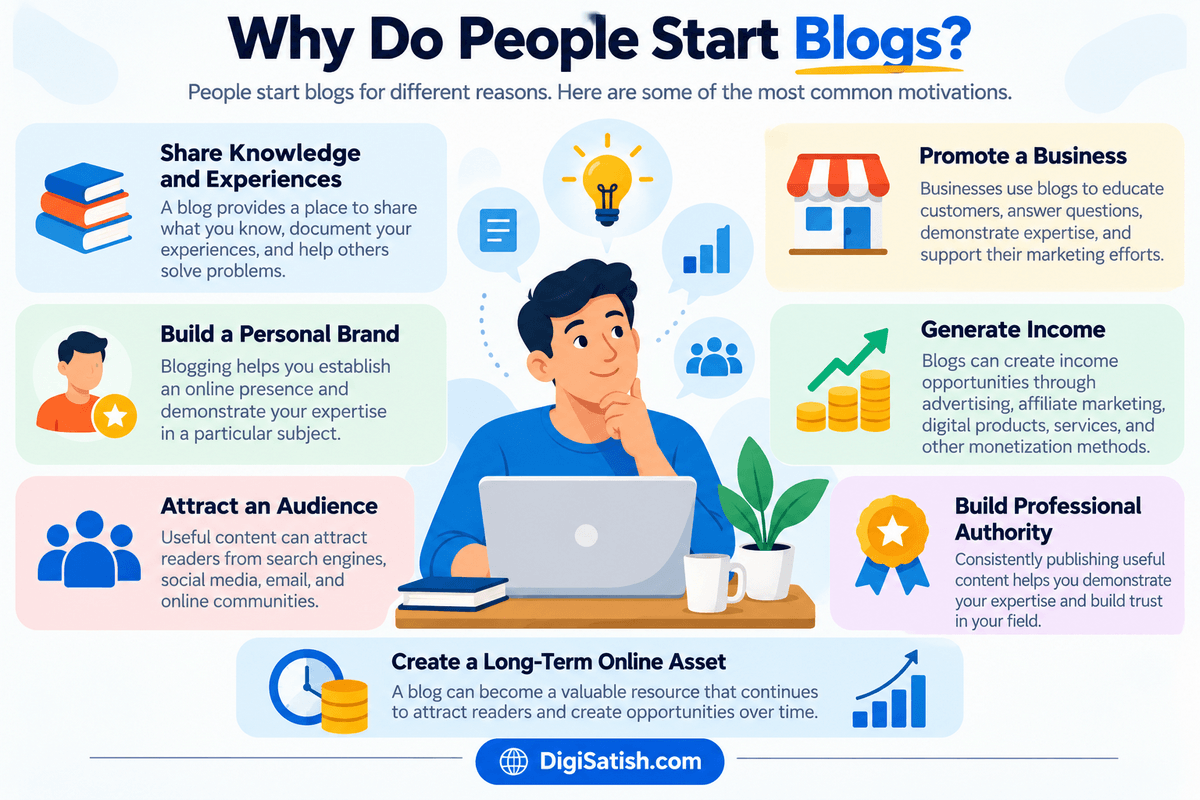
There is no single purpose for a blog. Your goals can determine the topics you publish, the audience you target, and the way you measure success.
1. Share Knowledge and Experiences
One of the simplest reasons to start a blog is to share knowledge, experiences, and ideas with other people.
A blog provides a place to explain what you have learned, document your experiences, answer questions, and help others solve problems. For example, a teacher might publish educational resources, while a technology enthusiast might write tutorials about software and gadgets.
Blogging can also allow you to organize your knowledge into a resource that people can discover and refer to later.
2. Build a Personal Brand
Blogging can be an effective way to build a personal brand around your knowledge, experience, interests, or professional skills.
By consistently publishing useful content on a particular subject, you can create an online presence that helps people understand what you know and what you can offer.
For professionals, a blog can complement other online profiles and provide a place to demonstrate expertise through detailed articles, tutorials, opinions, case studies, and practical advice.
3. Attract an Audience
Blogs can help individuals and businesses attract people who are interested in specific topics.
Search engines can send visitors to useful blog posts when those pages are relevant to what people are searching for. Social media, email newsletters, online communities, and links from other websites can also bring readers to a blog.
Over time, related articles can turn a collection of individual posts into a larger resource for a specific audience.
4. Promote a Business
Businesses often use blogs as part of their content marketing strategy.
A business blog can answer customer questions, explain products or services, provide tutorials, demonstrate expertise, and address problems faced by potential customers.
For example, a web hosting company might publish guides about website security and WordPress, while a software company might create tutorials showing customers how to use its products.
Blogging can therefore support different stages of the customer journey, from helping someone learn about a problem to helping them evaluate possible solutions.
5. Generate Income
Some people start blogs with the goal of creating income from their content and audience.
Depending on the niche and business model, bloggers may generate revenue through:
- Display advertising
- Affiliate marketing
- Sponsored content
- Digital products
- Online courses
- Consulting
- Freelance services
- Physical products
- Memberships or other paid offerings
However, starting a blog does not guarantee income. Monetization generally depends on factors such as audience size, content quality, traffic, niche, business model, and the products or services being offered.
6. Build Professional Authority
A blog can also help demonstrate expertise in a particular field.
Publishing detailed, accurate, and useful content allows professionals to explain their knowledge publicly. Over time, a well-maintained collection of content can demonstrate experience and provide potential clients, employers, customers, or collaborators with more information about the blogger’s area of expertise.
For this reason, blogging can be useful for professionals in fields such as technology, education, finance, marketing, consulting, design, and many other industries.
7. Create a Long-Term Online Asset
A blog can become a long-term online resource when it is consistently maintained and improved.
Unlike a social media post that may receive most of its attention shortly after publication, a useful blog article can continue attracting readers through search engines, direct visits, links from other websites, and other channels over time.
A collection of related articles can also create a valuable knowledge base around a particular subject.
Building this type of resource requires ongoing work. Older articles may need updates, new content may need to be added, and the website should continue to provide a useful experience for readers.
Ultimately, people start blogs for different reasons, but the common foundation is creating useful content for a specific audience. Whether the goal is education, personal branding, business growth, professional development, or monetization, the value of a blog comes from the information and experience it provides to its readers.
What Do Bloggers Write About?
Bloggers can write about almost any useful subject as long as there is an identifiable audience interested in the topic. A blog can focus on one specific subject, cover several closely related topics, or serve a particular group of readers.
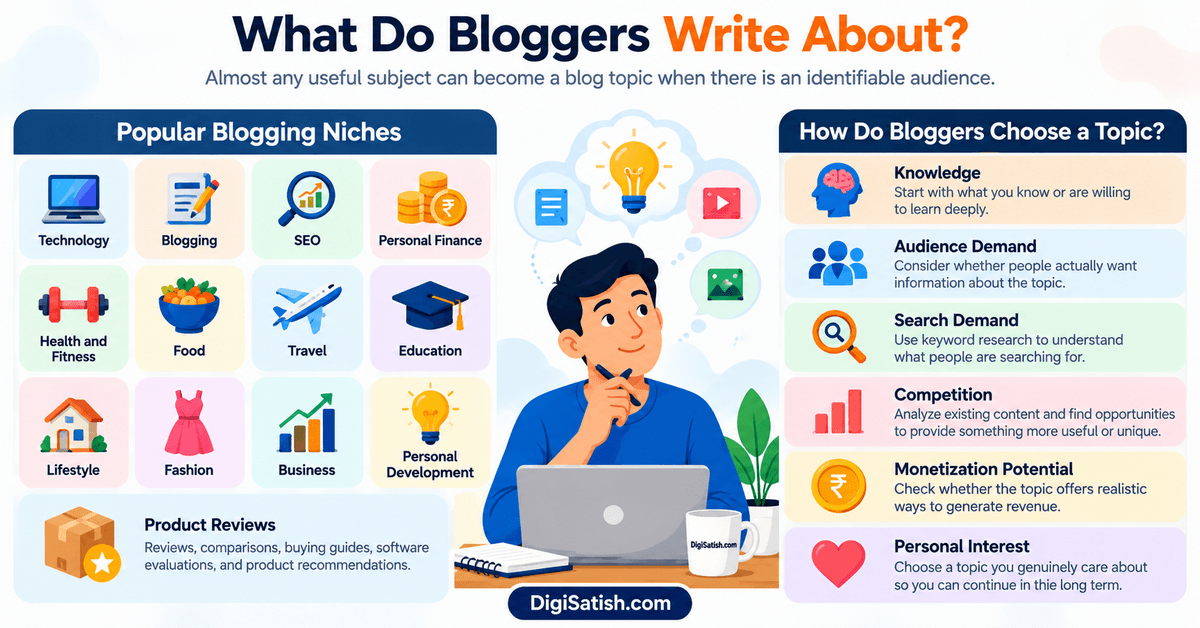
The best topics are usually those where the blogger can provide useful information, practical experience, original insights, or solutions to problems. A technology blogger, for example, might publish software tutorials and product reviews, while an education blogger might create study guides, teaching resources, and educational explainers.
Popular Blogging Niches
Some popular blogging niches include:
- Technology: Gadgets, software, apps, artificial intelligence, computers, and emerging technologies.
- Blogging: Blogging strategies, content creation, WordPress, traffic growth, and monetization.
- SEO: Search engine optimization, keyword research, link building, technical SEO, and content optimization.
- Personal finance: Saving money, budgeting, investing, credit, and financial planning.
- Health and fitness: Exercise, nutrition, wellness, healthy habits, and fitness routines.
- Food: Recipes, cooking techniques, restaurant experiences, food guides, and meal ideas.
- Travel: Destinations, travel guides, itineraries, accommodation, and travel tips.
- Education: Study resources, learning strategies, courses, academic subjects, and teaching resources.
- Lifestyle: Personal interests, home, relationships, hobbies, routines, and everyday experiences.
- Fashion: Clothing, styling, trends, accessories, and beauty-related topics.
- Business: Entrepreneurship, marketing, management, sales, productivity, and business strategy.
- Personal development: Productivity, career development, habits, motivation, and skills.
- Product reviews: Reviews, comparisons, buying guides, software evaluations, and product recommendations.
These niches can also be divided into smaller sub-niches. For example, instead of creating a general technology blog, a blogger could focus specifically on AI tools for content creators, smartphone photography, or Windows tutorials.
A narrower topic can make it easier to define the target audience and create a focused content strategy.
How Do Bloggers Choose a Topic?
Choosing a blog topic involves more than simply selecting something that seems popular. Bloggers often consider several factors before deciding what to write about.
- Knowledge: Start with what you know or are willing to learn deeply. Your existing knowledge, professional experience, skills, and interests can help you create more useful content. First-hand experience can also provide examples and insights that are difficult to obtain from simply rewriting information from other websites.
- Audience Demand: Consider whether people actually want information about the topic. Think about the questions they ask, problems they face, products they research, and information they need. A topic is more useful as a blogging opportunity when you can clearly identify the people you want to help.
- Search Demand: Search engines can provide valuable clues about what people are looking for online. Keyword research can help bloggers discover search queries related to their topic and understand the questions or problems behind those searches. However, search volume alone should not determine what you publish. The goal should be to create content that genuinely satisfies the searcher’s needs.
- Competition: Popular topics often have many websites competing for attention. Before choosing a topic, examine the existing content and consider whether you can provide something more useful, clearer, more detailed, more current, or based on genuine experience. Competition does not automatically mean you should avoid a topic. It can indicate that an established audience already exists.
- Monetization Potential: If your goal is to build a business, consider whether the topic offers realistic ways to generate revenue. Depending on the niche, potential monetization methods may include advertising, affiliate marketing, sponsored content, digital products, courses, consulting, services, or physical products. A topic should not be selected solely because it appears profitable. The audience’s needs and the value you can provide should remain central to the decision.
- Personal Interest: Finally, consider whether you can stay interested in the subject for the long term. Building a useful blog usually requires creating multiple pieces of content and maintaining older articles. Choosing a topic that you genuinely care about can make it easier to continue researching, writing, learning, and improving your content.
A practical way to evaluate a potential blogging topic is to look for an overlap between what you know, what people want, what they search for, what you can compete on, and what can support your long-term goals.
Types of Blogs
Blogs can be categorized in different ways based on their topic, audience, purpose, or business model. Some blogs focus on personal experiences, while others are created to educate readers, promote a business, generate revenue, or cover a specific subject.
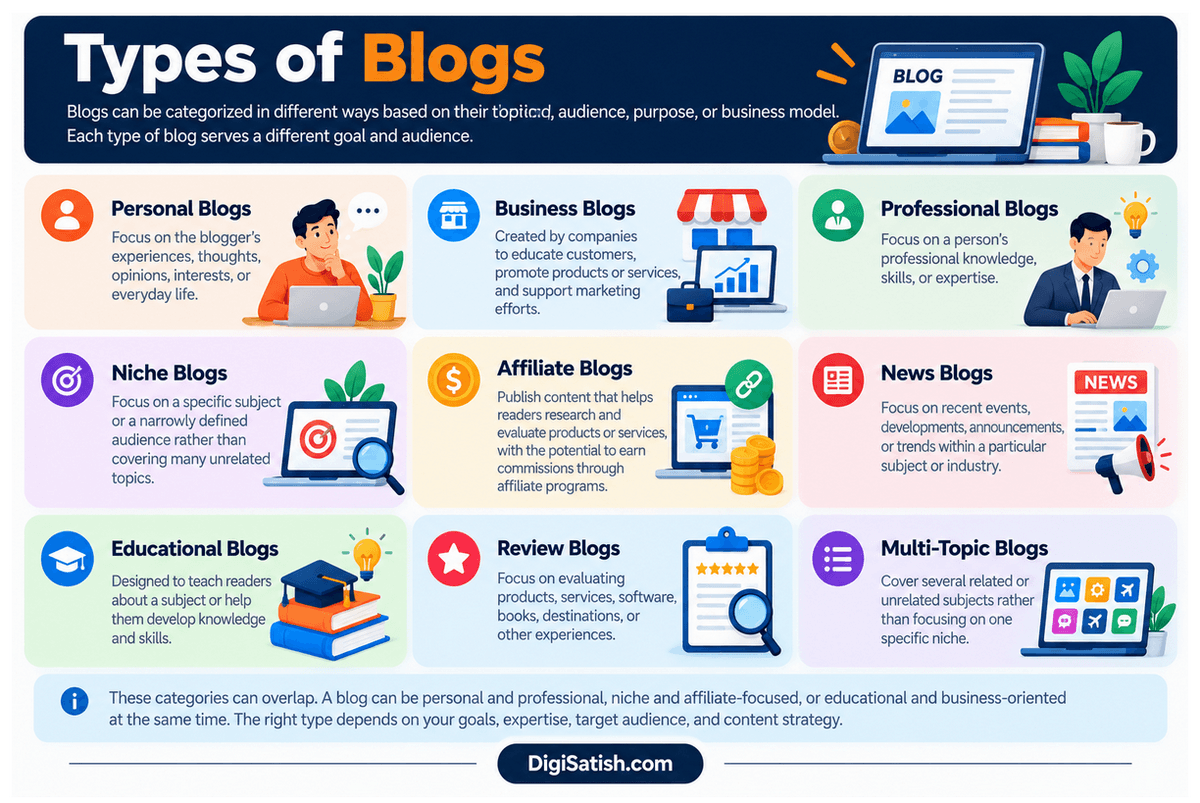
There is no single format that every blog must follow. The right type depends on the blogger’s goals, expertise, target audience, and content strategy.
1. Personal Blogs
A personal blog focuses primarily on the blogger’s experiences, thoughts, opinions, interests, or everyday life.
Personal blogs are suitable for people who want to document their experiences, share their perspectives, build an online presence, or connect with readers who have similar interests.
2. Business Blogs
A business blog is created by a company or organization to communicate with customers and potential customers.
Businesses can use blogs to answer questions, publish educational content, explain products or services, attract search traffic, and support their broader marketing strategy.
3. Professional Blogs
A professional blog focuses on a person’s professional knowledge, skills, or area of expertise.
It can be useful for consultants, freelancers, specialists, writers, educators, and other professionals who want to demonstrate their knowledge and establish an online professional presence.
4. Niche Blogs
A niche blog focuses on a specific subject or a narrowly defined audience rather than covering many unrelated topics.
For example, instead of creating a general technology blog, someone might focus specifically on artificial intelligence tools for content creators. Niche blogs are suitable for bloggers who want to develop focused expertise and serve a clearly defined audience.
5. Affiliate Blogs
An affiliate blog publishes content that can help readers research and evaluate products or services, with the potential to earn commissions from qualifying purchases or actions through affiliate programs.
Common formats include product reviews, comparisons, tutorials, and buying guides. Affiliate blogging is particularly suitable for creators who can provide useful product information and build an audience interested in specific products or services.
6. News Blogs
A news blog focuses on recent events, developments, announcements, or trends within a particular subject or industry.
Some news blogs cover broad current events, while others focus on areas such as technology, business, entertainment, or a specific industry. This type of blog is suitable for publishers who can research and report information accurately and consistently.
7. Educational Blogs
An educational blog is designed to teach readers about a particular subject or help them develop knowledge and skills.
Teachers, educators, subject-matter experts, educational institutions, and students can use this type of blog to publish lessons, study resources, explainers, tutorials, and learning guides.
8. Review Blogs
A review blog focuses on evaluating products, services, software, books, destinations, or other experiences.
Review bloggers may publish detailed reviews, comparisons, testing results, and buying guides. This type of blog is suitable for creators who can provide useful evaluations and, where possible, first-hand experience with the subjects they review.
9. Multi-Topic Blogs
A multi-topic blog covers several related or unrelated subjects rather than focusing on one specific niche.
For example, a blogger might publish articles about technology, blogging, online tools, productivity, and personal development on the same website.
Multi-topic blogs can be suitable for experienced publishers who want to cover several areas, although maintaining a clear audience and consistent content strategy can be more challenging when the subjects are too unrelated.
Ultimately, these categories can overlap. A blog can be personal and professional, niche and affiliate-focused, or educational and business-oriented at the same time. What matters most is having a clear purpose and creating content that is useful to the audience you want to reach.
What Are the Benefits of Blogging?
Blogging can provide several benefits for individuals, professionals, creators, and businesses. The specific benefits depend on the purpose of the blog, the quality of its content, the audience it serves, and how consistently it is maintained.
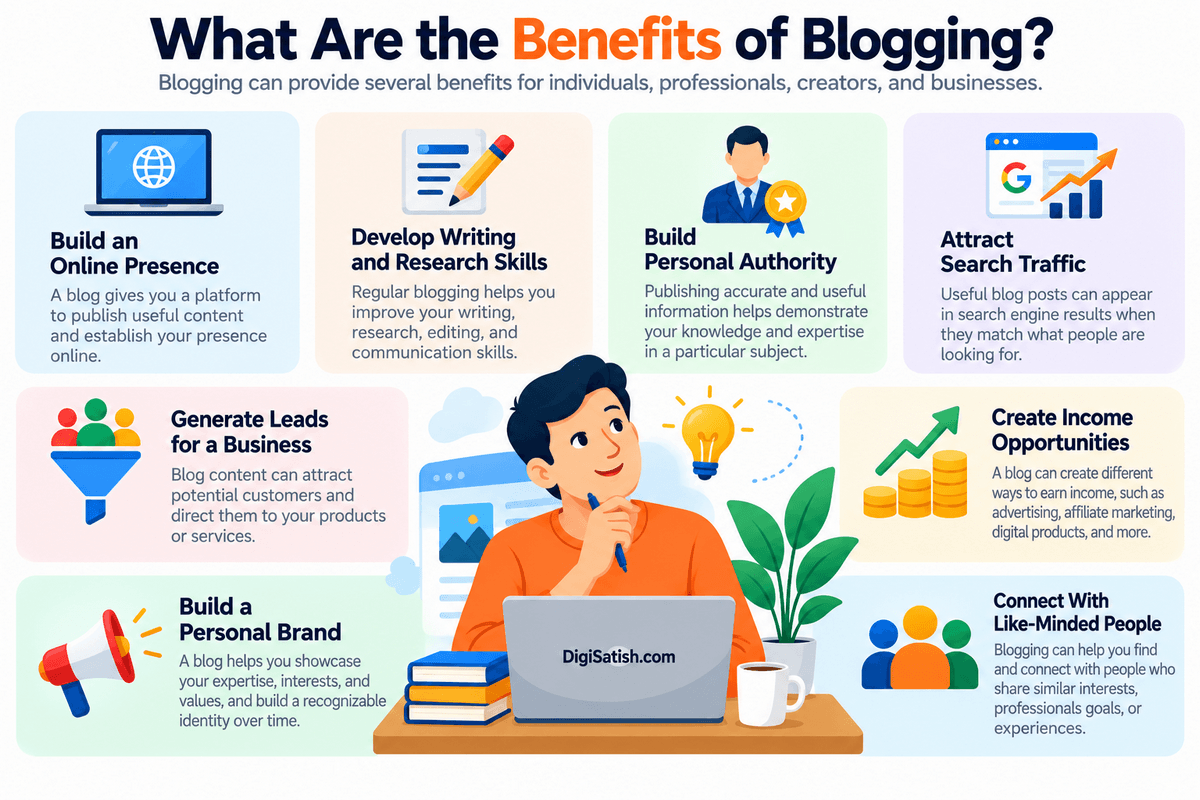
A blog can help you establish an online presence, demonstrate your expertise, attract relevant visitors, develop valuable skills, and create opportunities for business or income. However, blogging does not guarantee search rankings, traffic, or earnings. These results depend on many factors and usually require time and consistent effort.
1. Build an Online Presence
A blog gives you a place to publish information under your own name or brand. Instead of relying entirely on social media profiles or third-party platforms, you can build a collection of content on your own website.
Over time, useful articles can make it easier for people to discover your knowledge, interests, products, or services online.
Develop Writing and Research Skills
Regular blogging can help you improve your writing, research, editing, organization, and communication skills.
Creating a useful article often requires researching a topic, evaluating information, organizing ideas, and editing drafts using the right writing apps to streamline your workflow. These skills can also be valuable in education, professional work, marketing, and content creation.
2. Build Personal Authority
Publishing accurate and useful information about a subject can help demonstrate your knowledge and experience.
For example, a professional who consistently publishes detailed tutorials, explanations, case studies, or practical advice can use those articles as evidence of their experience in a particular field.
Building authority takes time and depends on the quality and credibility of the content rather than simply publishing a large number of articles.
3. Attract Search Traffic
Blog posts can appear in search engine results when they provide useful answers to queries that people are searching for.
By understanding search intent, creating helpful content, using relevant keywords naturally, and following good SEO practices, bloggers can improve the chances of their content being discovered through search.
However, SEO does not guarantee rankings or traffic. Search visibility depends on factors such as competition, content quality, relevance, website authority, technical factors, and changes to search algorithms.
4. Generate Leads for a Business
Businesses can use blog content to attract people who are researching problems, products, or services related to their industry.
For example, a software company might publish tutorials that help potential customers solve common problems. Relevant articles can then direct interested readers toward product pages, contact forms, newsletters, demonstrations, or other business resources.
This makes blogging a useful part of a broader content marketing and lead-generation strategy.
5. Create Income Opportunities
A blog can create different opportunities to generate income once it has an audience and useful content.
Depending on the niche and business model, potential revenue sources include:
- Display advertising
- Affiliate marketing
- Sponsored content
- Digital products
- Online courses
- Consulting
- Freelance services
- Physical products
The availability and effectiveness of these methods vary from one blog to another. Blogging should therefore be viewed as a long-term opportunity rather than a guaranteed way to make money.
6. Build a Personal Brand
A blog can serve as a central platform for developing a personal brand.
You can use your articles to communicate your expertise, experiences, opinions, interests, and professional skills. Your blog can also connect with other parts of your online presence, such as social media profiles, newsletters, podcasts, videos, or professional profiles.
Consistent publishing around relevant subjects can help create a recognizable identity over time.
7. Connect With Like-Minded People
Blogging can help you connect with people who share your interests, professional goals, or experiences.
Readers may discover your content through search engines, social media, communities, or recommendations. Comments, email, social networks, and other communication channels can then create opportunities for discussion and interaction.
These connections can lead to collaborations, professional relationships, feedback, or simply a community of people interested in the same subject.
Overall, the benefits of blogging extend beyond website traffic. A well-maintained blog can become a platform for learning, communication, personal branding, professional development, audience building, business growth, and potential income generation. The results, however, depend on the value you provide and the consistency with which you build and maintain the blog.
How Do Bloggers Make Money?
Blogging itself does not automatically generate income. Instead, bloggers generally make money by building an audience and connecting that audience with relevant products, services, advertisements, or business models.
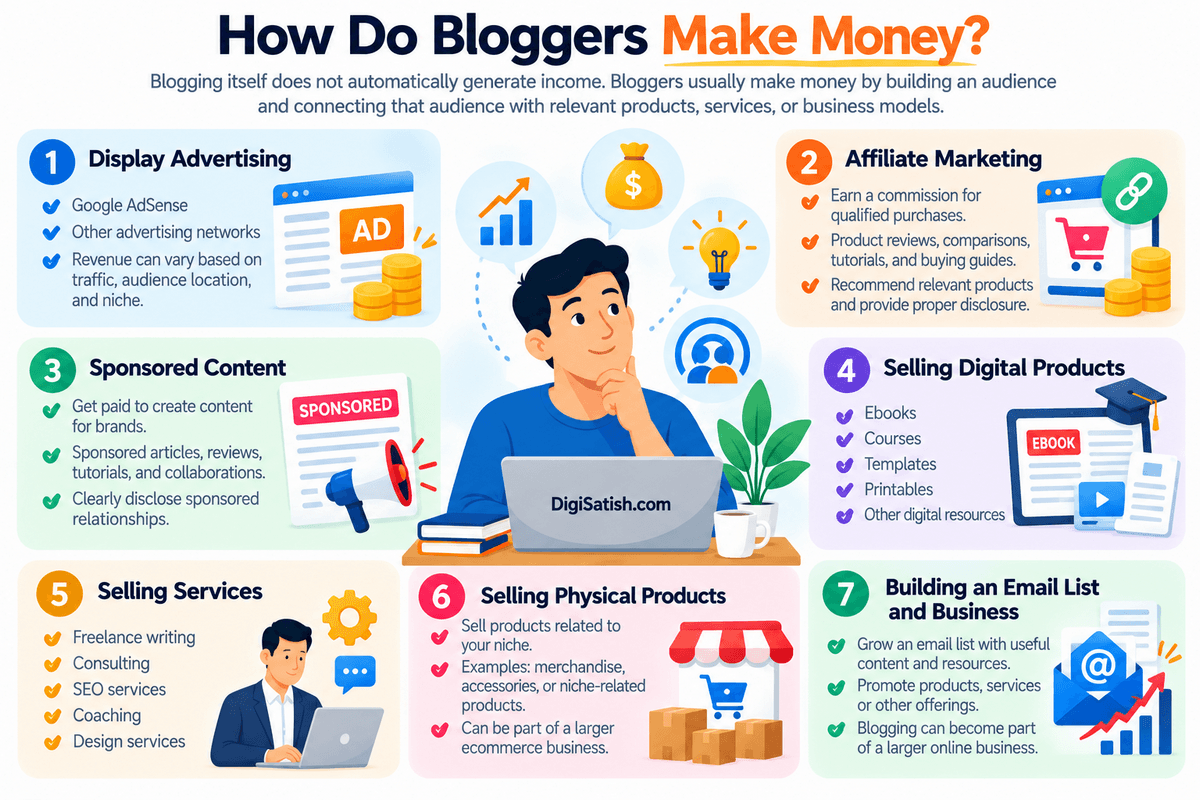
The right monetization method depends on the blog’s niche, audience, traffic, content, and business goals. Some bloggers use one primary revenue source, while others combine several methods.
1. Display Advertising
Display advertising allows bloggers to earn revenue by showing advertisements to visitors on their websites.
- Google AdSense: Google AdSense is one of the advertising platforms bloggers can use to display relevant ads on their websites. Depending on the advertising arrangement and traffic, publishers may earn revenue when visitors interact with advertisements. AdSense is relatively accessible to publishers, but eligibility and revenue depend on Google’s policies, the website, audience, advertising demand, and other factors.
- Other Advertising Networks: Bloggers can also explore other advertising networks depending on their traffic levels, location, niche, and eligibility. Different networks may have different requirements, ad formats, payment models, and approval processes. Bloggers should evaluate whether the advertisements provide reasonable value without creating a poor experience for visitors.
- How Traffic Can Affect Advertising Revenue: Advertising revenue is generally influenced by factors such as the number of visitors, page views, audience location, niche, advertising demand, and user engagement. More traffic can create more opportunities for ad impressions and interactions, but traffic alone does not guarantee a particular level of income. The value of traffic can vary significantly between websites and audiences.
2. Affiliate Marketing
Affiliate marketing allows bloggers to earn a commission when readers purchase a product or complete another qualifying action through a tracked affiliate link.
For example, a technology blogger might review a web hosting service, software product, or laptop and include an affiliate link where readers can learn more or make a purchase.
Product reviews, comparisons, tutorials, and buying guides are common formats for affiliate content because they can help readers evaluate products before making a decision.
The most important principle is relevance. Affiliate recommendations should be appropriate for the audience and genuinely useful rather than being added simply to generate commissions.
Bloggers should also provide appropriate affiliate disclosures when required by applicable laws, regulations, or affiliate-program policies. Readers should be able to understand when a blogger may receive compensation from a recommendation.
3. Sponsored Content
Sponsored content is another potential revenue source. A company may pay a blogger to create or publish content that promotes or discusses its product, service, or brand.
Sponsored content can take different forms, including:
- Sponsored articles
- Product features
- Reviews
- Tutorials
- Brand collaborations
The content should remain useful to the audience, and sponsored relationships should be clearly disclosed when required. Bloggers should also consider whether a sponsorship is relevant to their niche and consistent with the trust they have built with their readers.
4. Selling Digital Products
Bloggers can create and sell digital products based on their knowledge, expertise, or audience needs.
Examples include:
- Ebooks: Detailed guides or resources covering a specific subject.
- Courses: Structured educational programs that teach a skill or subject.
- Templates: Ready-to-use documents, spreadsheets, designs, prompts, or other resources.
- Printables: Digital worksheets, planners, checklists, educational materials, and similar resources.
Digital products can complement a blog because the articles can introduce readers to a subject while the paid product provides a more comprehensive resource.
5. Selling Services
A blog can also help professionals attract customers for services.
For example, bloggers may offer:
- Freelance writing
- Consulting
- SEO services
- Coaching
- Design services
Publishing useful content related to a service can demonstrate expertise and help potential customers understand the problems the blogger can solve.
For service-based businesses, the blog can therefore work alongside service pages, contact forms, email marketing, and other customer-acquisition channels.
6. Selling Physical Products
Some bloggers use their websites to sell physical products related to their audience and niche.
For example, a food blog could sell cooking-related products, while a fashion blog could sell clothing or accessories. A creator with an established audience might also develop branded merchandise.
In this model, blogging becomes part of a broader ecommerce or product business rather than being the sole source of revenue.
7. Building an Email List and Business
Blogging can also become the foundation of a larger online business.
A blogger can encourage interested readers to join an email list by offering useful newsletters, resources, updates, or other relevant content. Email allows the blogger to communicate with subscribers without relying entirely on search engines or social media platforms.
Over time, the blog and email audience can support a broader business that includes products, services, affiliate recommendations, courses, consulting, advertising, or other offerings.
For example, a blogger might use a free educational article to attract a visitor from search, offer a useful resource in exchange for an email subscription, and then introduce relevant products or services through their website and email newsletter.
The key is to build the business around providing genuine value to a clearly defined audience. Blogging can create opportunities for monetization, but income is not guaranteed and usually depends on factors such as audience demand, content quality, traffic, trust, niche economics, and the effectiveness of the chosen business model.
Blogging vs. Website: What Is the Difference?
A blog is a type of website, but not every website is a blog. The main difference is usually the purpose and how content is organized.
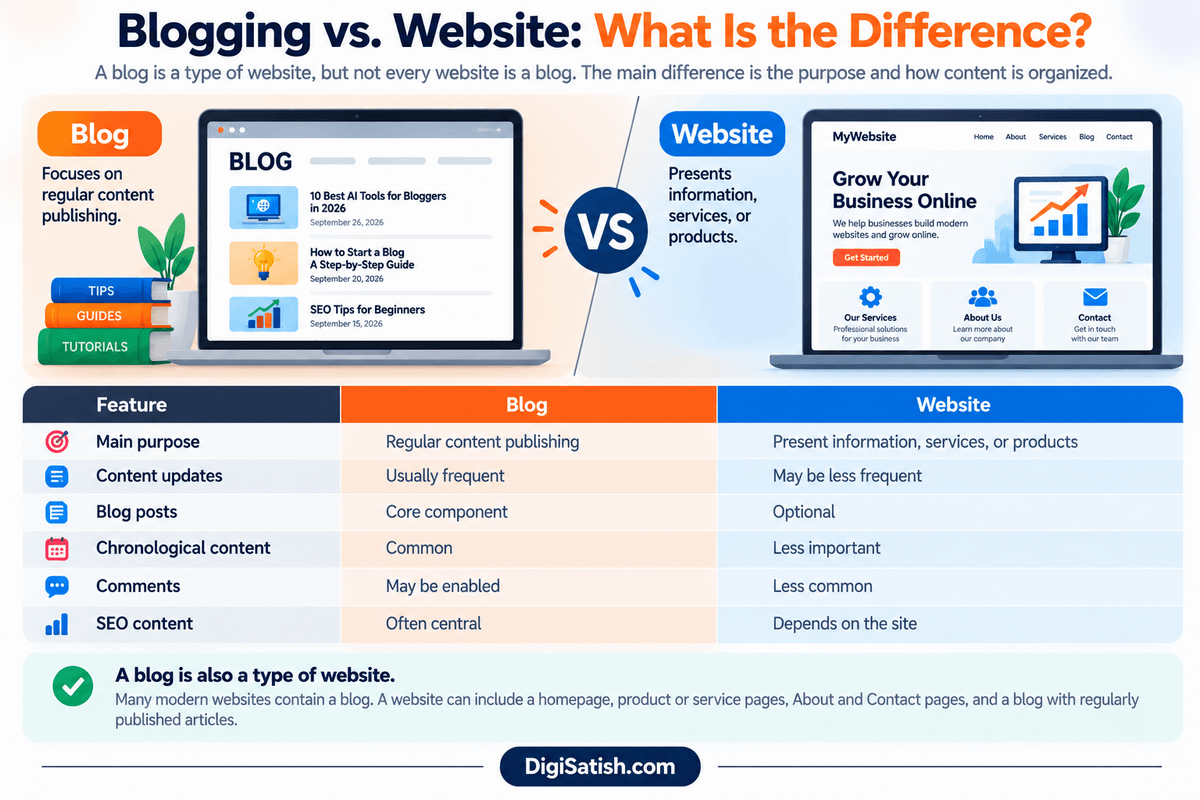
A blog is primarily designed to publish and update articles or other content regularly. A broader website may be designed mainly to present information about a person, business, organization, product, or service, with a blog serving as just one section of the site.
Here is a simple comparison:
| Feature | Blog | Website |
|---|---|---|
| Main purpose | Regular content publishing | Present information, services, or products |
| Content updates | Usually frequent | May be less frequent |
| Blog posts | Core component | Optional |
| Chronological content | Common | Less important |
| Comments | May be enabled | Less common |
| SEO content | Often central | Depends on the site |
Main Purpose
A blog is generally built around regularly publishing useful content for an audience. Articles are often the main focus of the website.
A business website, on the other hand, may focus on presenting products, services, company information, contact details, or other important pages. It may have a blog, but publishing articles may not be its primary purpose.
Content Updates
Blogs are usually updated more frequently because new posts are regularly added and older content may be updated.
A website that primarily provides information about a company or service may have pages that remain relatively stable and are updated only when important information changes.
Blog Posts
Blog posts are a core component of a blog. They allow the publisher to regularly add new information and organize it around different topics.
On a general website, blog posts are optional. A business, portfolio, ecommerce, or service website can operate without publishing a large collection of blog articles.
Chronological Content
Blogs commonly organize posts by publication date, with newer content appearing before older posts. Categories and tags may also be used to organize articles by subject.
Chronological organization is usually less important for standard website pages such as an About page, Services page, Contact page, or product page.
Comments
Some blogs allow readers to comment on articles, ask questions, or participate in discussions. However, comments are optional and many modern blogs choose not to enable them.
Comments are generally less common on standard business and informational website pages.
SEO Content
Search engine optimization can be an important part of blogging because regularly published articles can target different questions and search queries.
For a broader website, SEO can apply to product pages, service pages, category pages, landing pages, and other types of content. The importance of blog content therefore depends on the website’s goals and overall SEO strategy.
Is a Blog a Website?
Yes. A blog is essentially a type of website that focuses on regularly published content.
Many modern websites combine both approaches. For example, a company can have a homepage, product or service pages, About and Contact pages, and a blog containing educational articles.
Therefore, the distinction is not always about the technology used to build the site. It is mainly about how the website is structured, what purpose it serves, and how frequently its content is published and updated.
Blogging vs. Social Media: What Is the Difference?
Blogging and social media are both useful ways to publish content and reach an audience, but they work differently. A blog gives you greater control over your website and content, while social media platforms provide built-in audiences and platform-specific publishing tools.
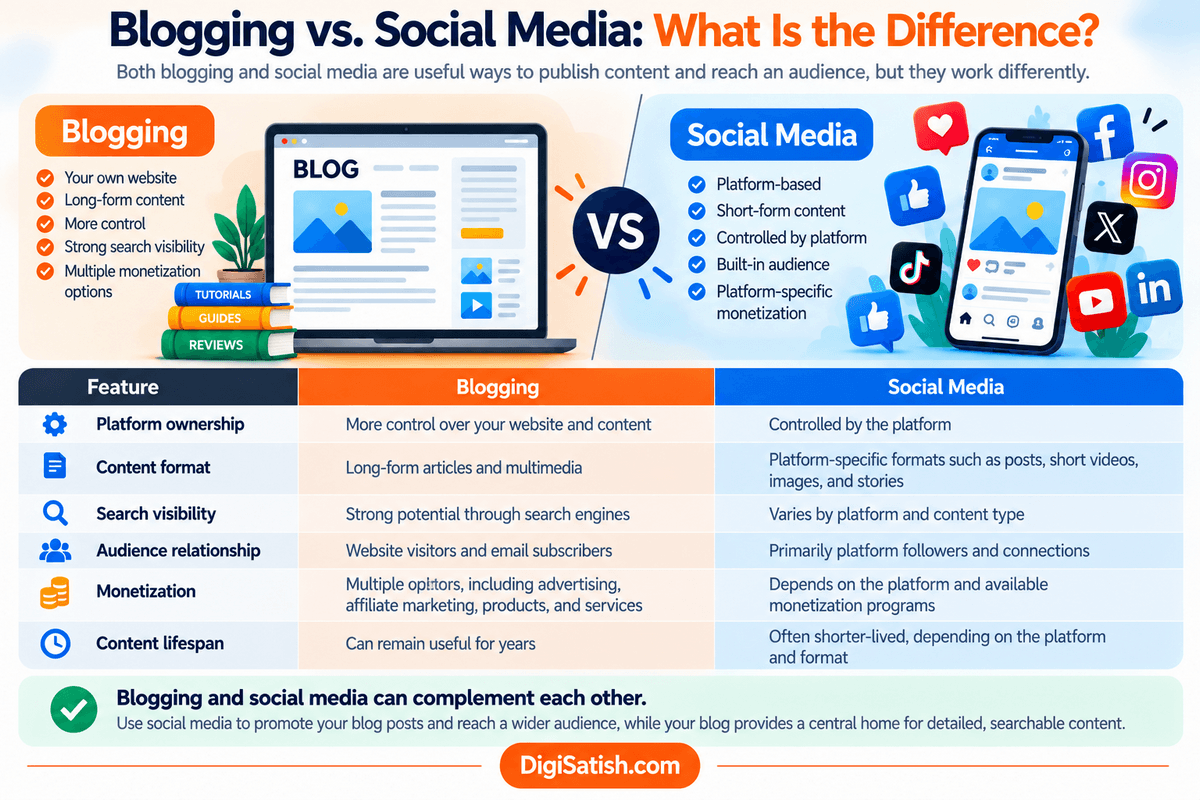
The two approaches do not have to compete with each other. Bloggers can use social media to promote their articles, while their blogs can provide a central home for detailed content, resources, and information.
| Feature | Blogging | Social Media |
|---|---|---|
| Platform ownership | More control over your website and content | Controlled by the platform |
| Content format | Long-form articles and multimedia | Platform-specific formats such as posts, short videos, images, and stories |
| Search visibility | Strong potential through search engines | Varies by platform and content type |
| Audience relationship | Website visitors and email subscribers | Primarily platform followers and connections |
| Monetization | Multiple options, including advertising, affiliate marketing, products, and services | Depends on the platform and available monetization programs |
| Content lifespan | Useful articles can remain relevant for years | Content often has a shorter active lifespan, depending on the platform and format |
Platform Ownership and Content Control
With a blog, you generally have more control over your website’s design, structure, content, domain, and publishing process.
Social media accounts, on the other hand, operate on platforms controlled by third-party companies. Each platform determines its features, rules, algorithms, content formats, and account policies.
This does not mean social media is less useful. It simply means that the level of control is different.
Content Format
Blogs are well suited to detailed articles, tutorials, guides, reviews, case studies, comparisons, and other long-form content. They can also incorporate images, videos, charts, downloadable resources, and other media.
Social media platforms generally emphasize formats designed specifically for their audiences, such as short posts, images, short-form videos, stories, live streams, and other interactive formats.
Search Visibility
Blog content can potentially attract visitors through search engines for months or even years when it remains relevant and continues to satisfy search intent.
Social media content can also be discovered through platform search and recommendation systems, but the level of discoverability varies considerably between platforms, content formats, and algorithms.
Audience Relationship
A blog provides a direct destination where readers can access your content. Bloggers can also build an email list, giving them another way to communicate with interested readers.
On social media, the audience relationship is primarily built through followers, subscribers, connections, and interactions within the platform.
Building an audience on both can provide complementary benefits.
Monetization
Blogs can support multiple monetization methods, including:
- Display advertising
- Affiliate marketing
- Sponsored content
- Digital products
- Courses
- Services
- Physical products
Social media monetization depends on the individual platform and its available programs. Depending on the platform, creators may have access to advertising revenue sharing, subscriptions, sponsorships, affiliate opportunities, product sales, or other features.
Content Lifespan
One major difference is how long content can remain useful.
A high-quality blog article can continue attracting visitors through search engines, internal links, external links, and direct traffic long after its original publication date.
Social media content can also remain discoverable, but many posts receive most of their attention shortly after publication. The lifespan varies significantly by platform, content type, audience, and algorithm.
Can Blogging and Social Media Work Together?
Yes. Blogging and social media can complement each other rather than being mutually exclusive.
For example, a blogger can publish a detailed guide on their website and then create social media posts, videos, or graphics that introduce the topic and direct interested people to the full article.
Similarly, social media can help a blog build awareness and attract an initial audience, while the blog provides a more permanent home for detailed information.
A practical content strategy can therefore use blogging for in-depth, searchable content and social media for distribution, engagement, and audience discovery.
Is Blogging Still Relevant in 2026?
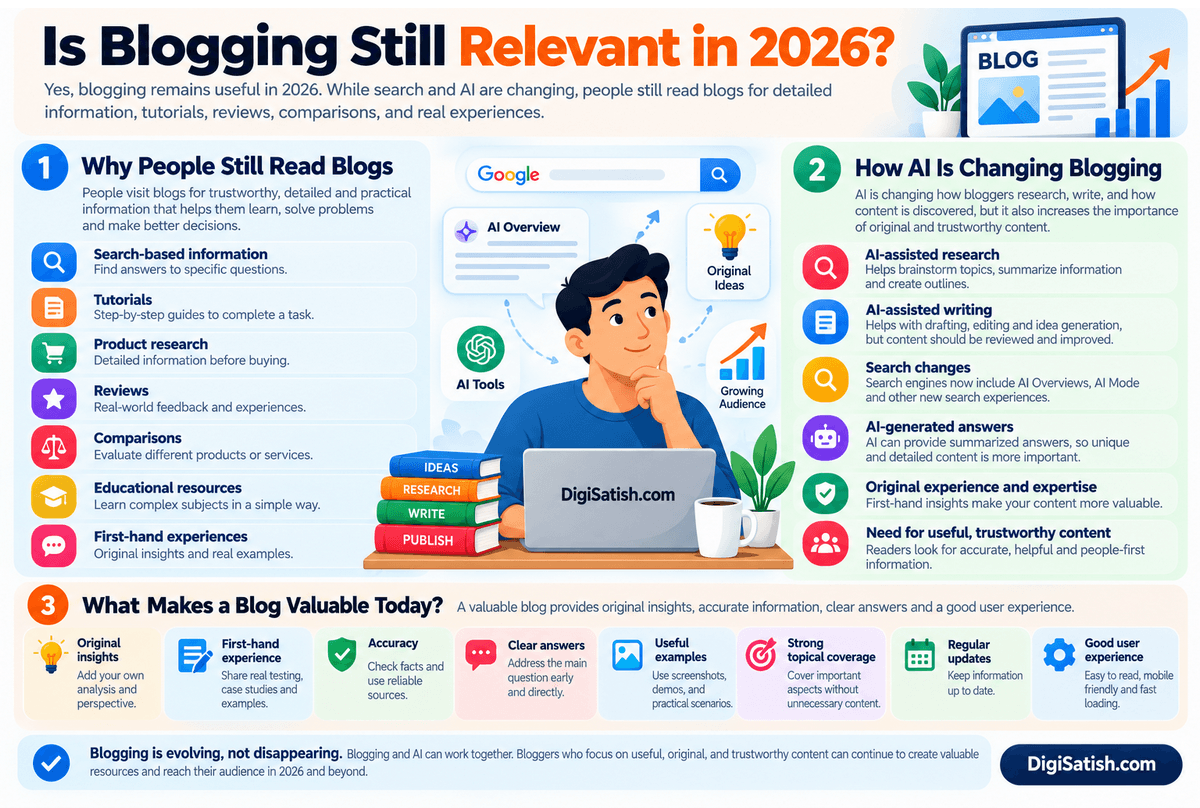
Yes, blogging remains useful in 2026, but the way people discover and consume blog content is changing. Search engines now provide a wider range of experiences, including AI-powered search features and multimodal search, while readers continue to look for detailed information, tutorials, reviews, comparisons, and first-hand experiences.
Google is also continuing to expand reporting around how websites appear in newer search experiences. Google for Developers
This means bloggers need to think beyond simply publishing articles and waiting for search traffic. The focus should be on creating content that provides information, experience, context, and value that readers can actually use.
Why People Still Read Blogs
People continue to visit blogs for many different types of information. While short-form content and social platforms can provide quick answers, detailed blog content remains useful when readers need more explanation, evidence, instructions, or comparisons.
Common reasons people read blogs include:
- Search-based information: Readers use search engines to find answers to specific questions and problems.
- Tutorials: Step-by-step articles can explain how to complete a task or use a product.
- Product research: Buyers often look for detailed information before purchasing a product or service.
- Reviews: Reviews can provide information about features, limitations, usability, and real-world experiences.
- Comparisons: Comparison articles can help readers evaluate different products, services, tools, or approaches.
- Educational resources: Blogs can explain complex subjects in a structured and accessible way.
- First-hand experiences: Personal testing, original observations, examples, and experiences can provide information that generic summaries may not offer.
A useful blog therefore does not need to compete with every form of online content. It can focus on answering questions thoroughly and providing information that is genuinely useful to its intended audience.
How AI Is Changing Blogging
Artificial intelligence is changing both how bloggers create content and how readers discover information.
- AI-Assisted Research: Bloggers can use AI tools for bloggers to brainstorm topics, organize research questions, summarize information, identify related concepts, and develop content outlines. However, AI-assisted research should not replace checking important information against reliable sources. Bloggers remain responsible for the accuracy of what they publish.
- AI-Assisted Writing: AI tools can help with tasks such as drafting, rewriting, editing, summarizing, and generating ideas. They can make parts of the content-production process more efficient. However, simply generating large amounts of generic AI-written content does not automatically make a blog useful. The finished article should be reviewed, edited, fact-checked, and improved with relevant expertise, examples, and original insights.
- Search Changes: Search is becoming more diverse. Google now documents AI Overviews and AI Mode alongside traditional search experiences, and Search Console has also introduced reporting for newer multimodal search activity. For bloggers, this means search visibility is no longer only about appearing as a traditional blue link. Content may be discovered through different search interfaces and formats.
- AI-Generated Answers: AI-powered search experiences can provide users with synthesized answers based on information from multiple sources. Google describes AI Overviews and AI Mode as experiences that can use web sources to provide topic or query previews. This makes it increasingly important for publishers to provide clear, accurate, distinctive information rather than producing content that simply repeats commonly available material.
- Importance of Original Experience and Expertise: First-hand experience can make a blog more useful. For example, a technology blogger who actually tests software can explain what happened during the installation, what features worked well, what limitations appeared, and who might benefit from the product. Likewise, an educator can provide practical examples, while a professional can explain how a strategy works in real-world situations. Original experience gives readers information that is difficult to obtain from a generic summary.
- Need for Useful, Trustworthy Content: AI does not remove the need for trustworthy information. In fact, as automated content becomes easier to produce, readers have more reason to look for information that is accurate, transparent, well researched, and genuinely helpful.
Google’s Search guidance emphasizes creating helpful, reliable, people-first content, while its page-experience guidance also encourages publishers to provide an overall good experience for visitors.
What Makes a Blog Valuable Today?
A valuable blog is not necessarily the one that publishes the most articles. It is one that consistently provides information that readers can trust and use.
Important qualities include:
- Original Insights: Add your own analysis, observations, examples, experiences, or perspective instead of simply repeating information available elsewhere.
- First-Hand Experience: When appropriate, demonstrate that you have actually used, tested, studied, or experienced the subject you’re discussing.
- Accuracy: Check factual claims, statistics, specifications, dates, prices, and other important information. Link to reliable sources when additional verification is useful.
- Clear Answers: Answer the reader’s main question early and explain the subject in a logical structure. Avoid making readers search through unnecessary information to find the answer.
- Useful Examples: Examples, screenshots, demonstrations, case studies, comparisons, and practical scenarios can make an article easier to understand and apply.
- Strong Topical Coverage: Cover the important aspects of a subject without adding unnecessary information simply to increase word count. Related articles can also work together to build a useful topical resource.
- Regular Updates: Information can become outdated, particularly in areas such as technology, software, SEO, finance, and online services. Review important articles periodically and update information when necessary.
- Good User Experience: Make articles easy to read and navigate. Use clear headings, appropriate images, readable typography, internal links, mobile-friendly layouts, and reasonable page performance. Google specifically recommends considering factors such as Core Web Vitals, mobile usability, intrusive elements, and overall page experience.
So, Is Blogging Still Relevant in 2026?
Blogging is evolving rather than simply disappearing. The role of a blog can extend beyond attracting traditional search clicks: it can demonstrate expertise, provide detailed resources, support a personal brand, educate an audience, promote products or services, and become part of a larger online business.
The important shift is from “publishing more content” to “publishing more useful content.” Bloggers who combine original knowledge, first-hand experience, accurate information, clear answers, useful examples, and a good reader experience can continue to create valuable online resources even as search and AI technologies change.
There is no need to assume that blogging is “dead” or that AI will automatically replace bloggers. The more useful question is how blogging should adapt to the way people discover, evaluate, and consume information in 2026.
What Do You Need to Start Blogging?
Starting a blog does not require advanced technical skills or a large budget. You mainly need a clear topic, a domain name, web hosting, a blogging platform, a content plan, and enough time to publish useful content consistently.
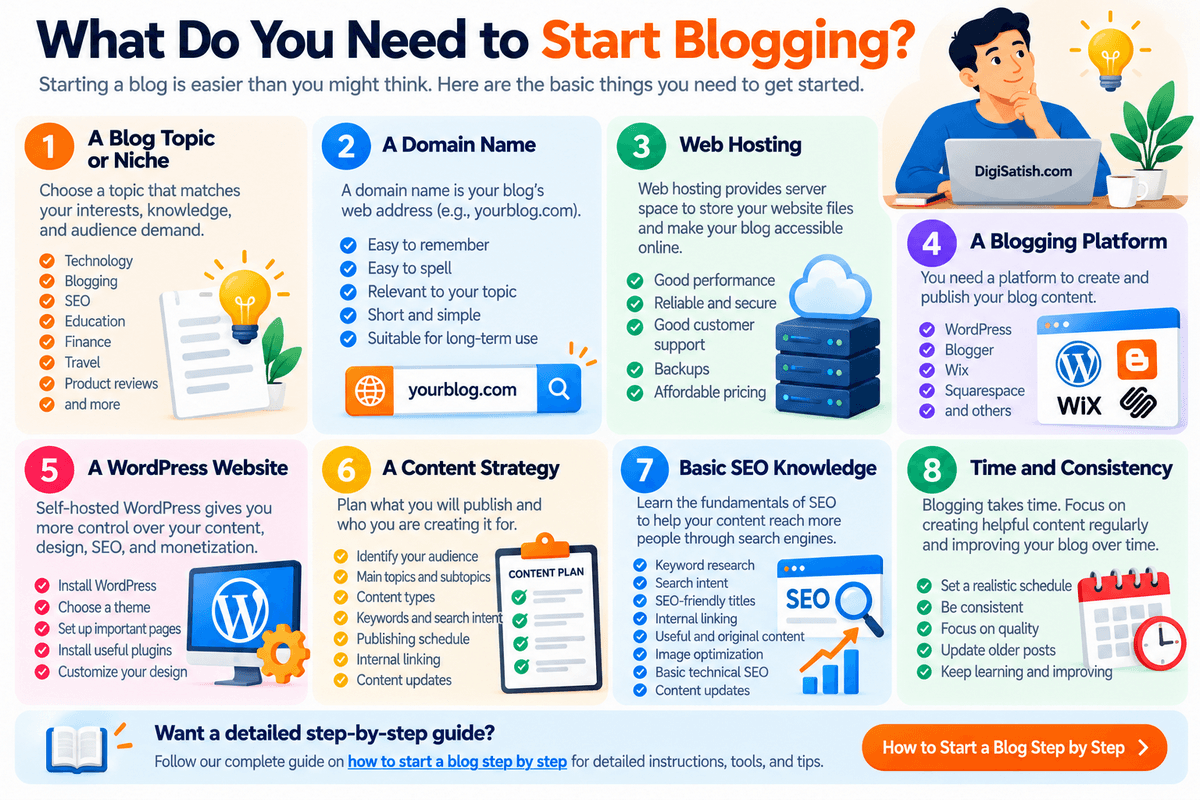
Here are the basic things you need to start blogging.
A Blog Topic or Niche
The first step is deciding what your blog will be about. Your topic or niche should ideally match your knowledge, interests, audience demand, and the type of content you want to create.
For example, you could start a blog about technology, blogging, SEO, education, personal finance, travel, food, health, or product reviews.
Choosing a focused topic can make it easier to build relevant content and attract the right audience.
A Domain Name
A domain name is the web address people use to visit your blog, such as example.com.
Choose a domain name that is:
- Easy to remember
- Easy to spell
- Relevant to your brand or topic
- Short enough to type easily
- Suitable for long-term use
Your domain name becomes an important part of your online identity, so avoid choosing one based only on a temporary trend.
Web Hosting
Web hosting provides the server space needed to store your website files and make your blog accessible online.
If you plan to build a self-hosted WordPress blog, you will need a hosting provider that supports WordPress. When comparing hosting services, consider factors such as performance, reliability, security, customer support, backups, and pricing.
A Blogging Platform
You also need a platform for creating and publishing your blog content.
There are several blogging platforms available, including WordPress, Blogger, Wix, Squarespace, and others. Each platform has different features, customization options, pricing, and levels of control.
For bloggers who want greater control over their website, content, design, SEO, and monetization, self-hosted WordPress is a commonly used option.
A WordPress Website
If you choose self-hosted WordPress, you will need to install WordPress on your hosting account and configure your website.
You can then select a suitable theme, install useful plugins, create important pages, and customize your site’s design.
Your WordPress website becomes the foundation for publishing articles, building an audience, improving search visibility, and eventually adding monetization methods.
A Content Strategy
Having a blog is not enough. You also need a plan for what you are going to publish and who you are creating it for.
A basic content strategy should identify:
- Your target audience
- Main topics and subtopics
- Content types you will publish
- Keywords and search intent
- Publishing priorities
- Internal linking opportunities
- Content updates
Instead of publishing random articles, organize related topics into content clusters. This can help you build deeper coverage of your niche over time.
Basic SEO Knowledge
You do not need to become an SEO expert before starting a blog, but understanding basic SEO can help your content reach more people through search engines.
Start by learning the fundamentals of:
- Keyword research
- Search intent
- SEO-friendly titles and headings
- Internal linking
- Useful and original content
- Image optimization
- Basic technical SEO
- Content updates and optimization
As your blog grows, you can gradually learn more advanced SEO techniques.
Time and Consistency
Blogging requires time to research topics, create content, optimize articles, promote your work, and update older posts.
You do not necessarily need to publish every day. A realistic publishing schedule that you can maintain consistently is usually more useful than creating a large amount of content for a short period and then stopping.
Focus on creating helpful content regularly and improving your blog based on what your audience needs.
You don’t need expensive software to begin, but using the best apps for writing blog posts will make drafting articles significantly smoother.
If you want to move from these basic requirements to the actual setup process, follow this detailed guide on how to start a blog step by step.
How to Start Blogging
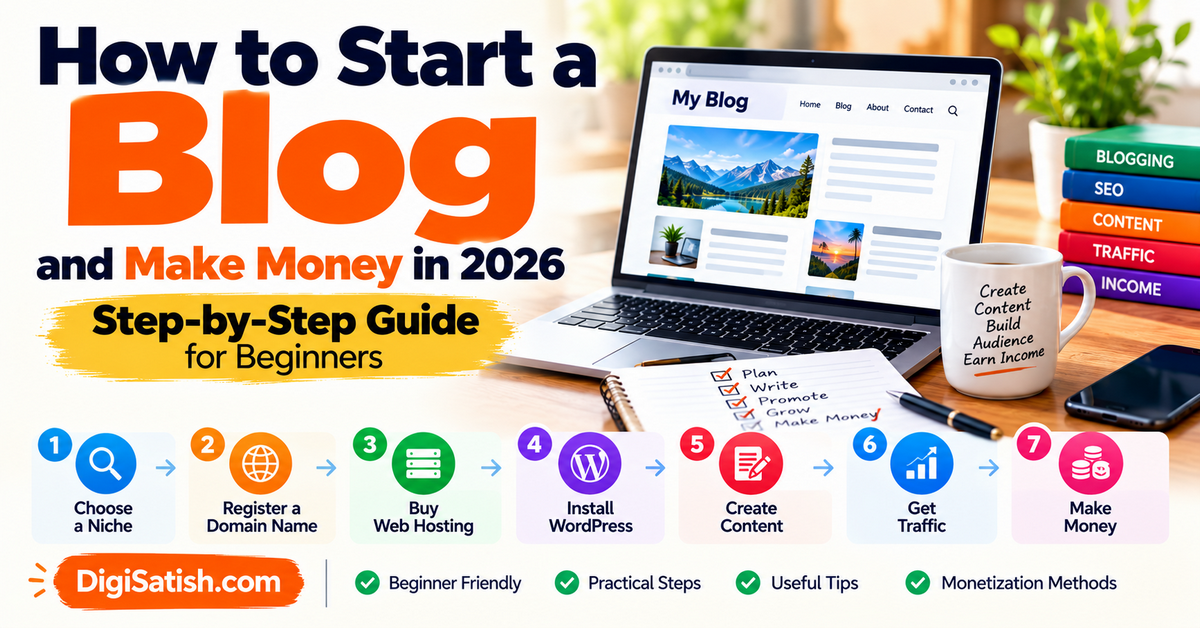
Starting a blog involves several simple steps, from choosing your topic and domain name to publishing content and promoting your website. You do not need to master everything before you begin. You can learn and improve your blogging skills as your website grows.
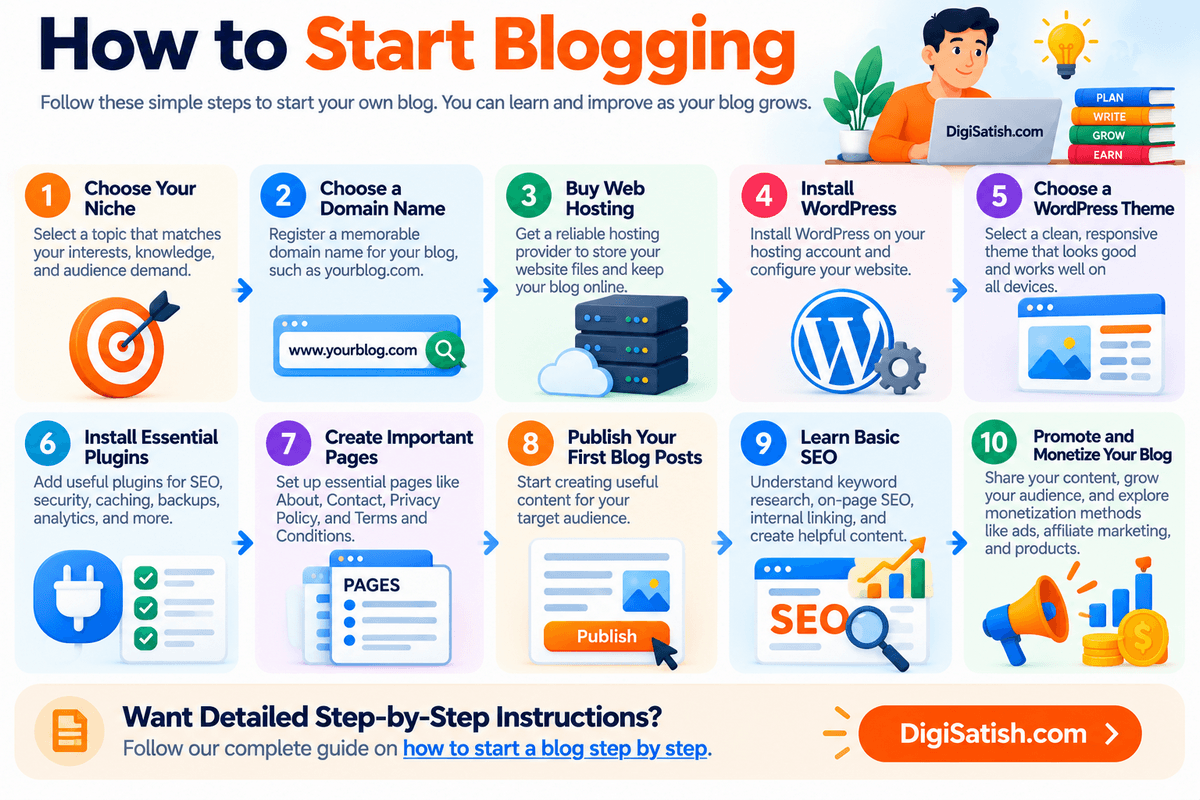
Here is a simple overview of the blogging process.
1. Choose Your Niche
Start by choosing a specific topic or niche you want to write about. Consider your knowledge, interests, audience demand, search potential, and long-term ability to create useful content.
A focused niche can make it easier to understand your target audience and build a collection of related content.
2. Choose a Domain Name
Choose a memorable domain name for your blog. Ideally, it should be easy to spell, pronounce, remember, and type.
Try to select a domain that can grow with your brand instead of limiting you to a very narrow topic.
3. Buy Web Hosting
Purchase web hosting to store your website files and make your blog available online.
When selecting a hosting provider, consider performance, reliability, security, customer support, backups, WordPress compatibility, and pricing.
4. Install WordPress
After purchasing hosting, install WordPress and configure your new website.
WordPress provides the foundation for creating pages, publishing blog posts, managing media, installing themes and plugins, and customizing your website.
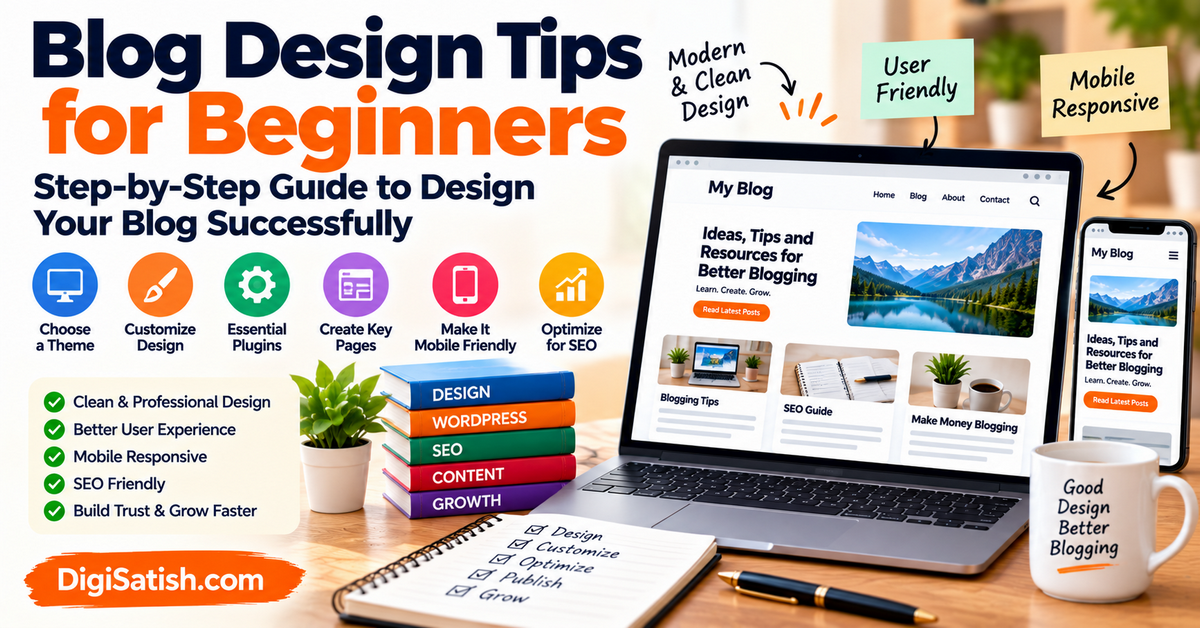
5. Choose a WordPress Theme
Select a WordPress theme that provides a clean, responsive, and user-friendly design.
Your theme should deliver a blog design that works smoothly across mobile devices, loads quickly, and offers the customization options needed for your content.
Avoid choosing a theme only because it looks attractive. Performance, usability, accessibility, and maintainability are also important.
6. Install Essential Plugins
WordPress plugins can add features and functionality to your website without requiring you to develop everything yourself.
Depending on your needs, you may use plugins for SEO, security, caching, backups, analytics, contact forms, image optimization, and other functions.
Install only the plugins you actually need and keep them updated.
7. Create Important Pages
Before publishing lots of articles, create the essential pages your visitors may expect to find.
These commonly include:
- About page
- Contact page
- Privacy Policy
- Terms and Conditions
- Affiliate Disclosure, when applicable
The exact pages you need can depend on your website, audience, location, and business model.
8. Publish Your First Blog Posts
Start creating useful content for your target audience.
Instead of publishing random topics, begin with articles that answer important questions within your niche. Research the topic, understand search intent, organize the information clearly, and provide practical value.
As your blog grows, build related articles around your main topics and connect them through relevant internal links.
9. Learn Basic SEO
Search engine optimization can help search engines understand your content and help people discover your articles through search.
Start with the fundamentals, including keyword research, search intent, descriptive titles, useful headings, internal linking, image optimization, and creating helpful content.
You do not need advanced SEO knowledge on day one. Learn the basics first and improve your skills as you publish more content.
10. Promote and Monetize Your Blog
Publishing content is only one part of blogging. You can also promote your articles through social media, email, online communities, networking, and other appropriate channels.
Once your blog has useful content and an audience, you can explore monetization methods such as display advertising, affiliate marketing, sponsored content, digital products, or services.
Choose monetization methods that are relevant to your audience and appropriate for your niche.
Start Your Blog Step by Step
The ten steps above provide the basic roadmap, but each step involves important decisions about domains, hosting, WordPress configuration, themes, plugins, content creation, SEO, and monetization.
If you are ready to build your own website, follow our complete how to start a blog step by step guide for detailed instructions from choosing a niche and domain name to setting up WordPress, publishing content, attracting visitors, and exploring ways to monetize your blog.
Common Blogging Mistakes Beginners Should Avoid
Starting a blog is relatively simple, but building a useful and sustainable blog requires avoiding some common mistakes. Many beginners focus too much on publishing quickly or getting immediate traffic and overlook important areas such as search intent, content quality, internal linking, and long-term audience building.
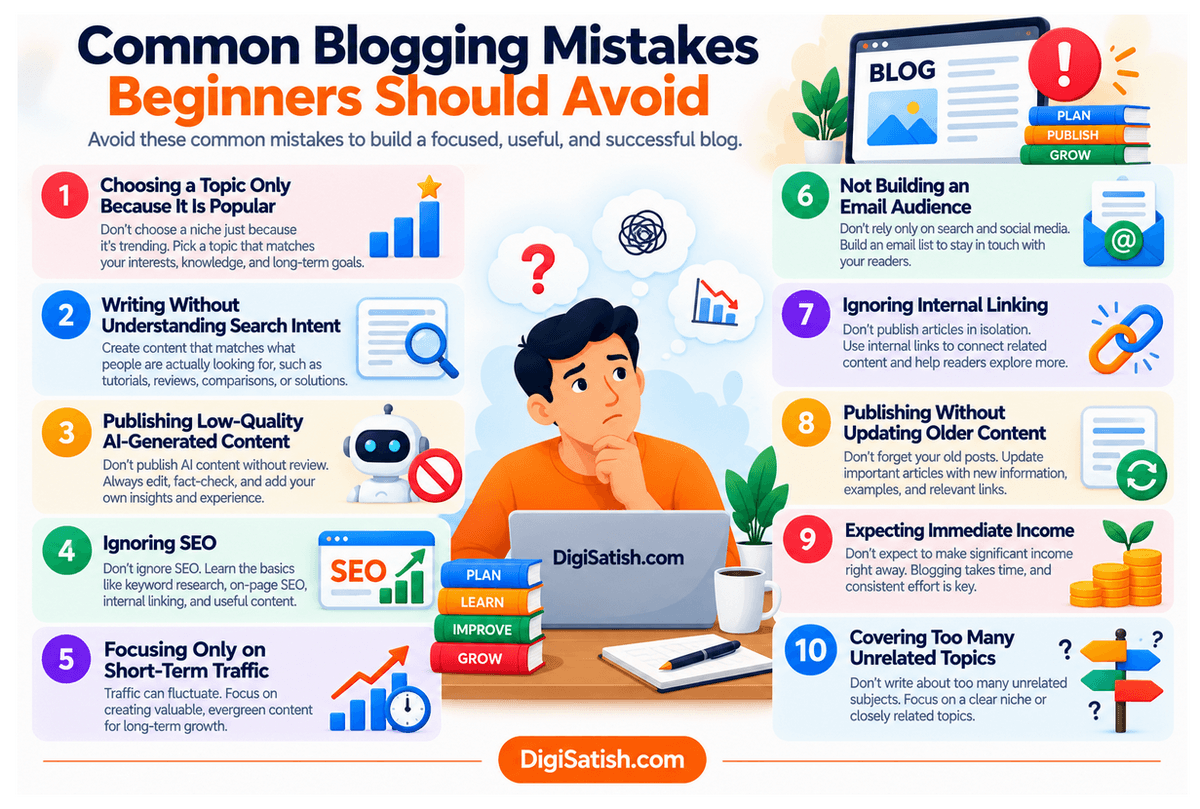
Here are some common blogging mistakes beginners should avoid.
Choosing a Topic Only Because It Is Popular
A popular topic may have a large audience, but that does not automatically make it the right niche for you.
Before choosing a topic, consider your knowledge, experience, interests, audience needs, search demand, competition, and ability to create useful content consistently.
A topic that you can cover deeply and accurately may be more sustainable than simply chasing whatever topic is currently trending.
Writing Without Understanding Search Intent
Creating an article around a keyword without understanding what people actually want to find can lead to disappointing results.
Before writing, examine the search query and determine whether people are looking for:
- An explanation
- A tutorial
- A product or service
- A comparison
- A review
- A list of options
- A solution to a specific problem
Your content should address the main purpose behind the search rather than simply repeating the target keyword.
Publishing Low-Quality AI-Generated Content
AI tools can help with brainstorming, research organization, outlines, editing, and other parts of the content creation process. However, publishing AI-generated text without meaningful human review can result in generic, inaccurate, repetitive, or unhelpful content.
If you use AI during your workflow, take the time to humanize AI-generated content by reviewing the information carefully, adding your own experience and insights, verifying important claims, and ensuring the final article is genuinely useful to readers.
The goal should be better content, not simply producing more content faster.
Ignoring SEO
You do not need to become an advanced SEO expert before starting a blog, but completely ignoring SEO can make it harder for search engines and readers to discover your content.
Learn the basics of keyword research, search intent, descriptive titles, headings, internal links, image optimization, useful content, and technical website performance.
SEO should support your content rather than become an excuse to write primarily for search engines.
Focusing Only on Short-Term Traffic
Traffic can fluctuate because of search algorithm changes, trends, seasonal interest, competition, and other factors.
Instead of focusing entirely on short-term traffic spikes, build content that can remain useful over time. Create comprehensive resources, answer recurring questions, build topical coverage, and update important articles when information changes.
A long-term approach can help turn individual articles into a stronger overall content library.
Not Building an Email Audience
Search traffic and social media can help people discover your blog, but they are not the only ways to build an audience.
Consider creating an email newsletter where appropriate. You can use it to share new articles, useful resources, updates, tutorials, or other content that your audience finds valuable.
An email audience can also provide another way to communicate with readers instead of relying entirely on search engines or social platforms.
Ignoring Internal Linking
Publishing articles without connecting them to other relevant pages can make it harder for readers to discover related information.
Implement strategic contextual internal links to connect related articles across your site. For example, a beginner-focused guide about blogging can link directly to detailed resources covering niche selection, starting a WordPress blog, keyword research, SEO, and blog monetization.
Internal linking can help readers navigate your website while also creating a clearer content structure.
Publishing Without Updating Older Content
A blog does not end when an article is published. Some information can become outdated, links can stop working, statistics can change, and better examples may become available.
Review important older articles periodically. Update outdated information, improve weak sections, add relevant internal links, replace broken links, and make the article more useful where necessary.
Not every article needs frequent updates, but important evergreen content should not simply be forgotten after publication.
Expecting Immediate Income
One of the biggest mistakes beginners make is expecting a new blog to generate significant income immediately.
Blogging income can depend on factors such as content quality, audience size, search visibility, niche, monetization method, traffic sources, and the products or services being promoted.
Instead of focusing only on immediate earnings, concentrate first on building a useful website, publishing valuable content, attracting the right audience, and developing sustainable traffic and monetization opportunities.
Covering Too Many Unrelated Topics
A new blog can become difficult to manage when it covers completely unrelated subjects without a clear purpose.
For example, publishing articles about technology, gardening, personal finance, cooking, travel, and fitness on the same small website may make it difficult to establish a clear audience and content structure.
This does not mean a blog must cover only one narrow subject. You can cover multiple closely related topics as long as they make sense for your audience and overall website.
A clear topical structure also makes it easier to organize content into related clusters and create useful internal links.
Avoiding these mistakes does not guarantee blogging success, but it can help you build a more focused, useful, and sustainable blog. Focus on understanding your audience, creating genuinely helpful content, learning SEO fundamentals, and improving your website over time.
Frequently Asked Questions About Blogging
What is blogging in simple words?
Blogging is the process of creating and publishing useful content on a website, usually in the form of regularly updated articles called blog posts. Bloggers can write about personal experiences, education, technology, business, hobbies, reviews, or other topics. Blogging can be used to share knowledge, build an audience, promote a business, or create income opportunities.
What is the purpose of blogging?
The purpose of blogging is to share useful information, attract an audience, build authority, or support personal and business goals. People blog to teach, inform, entertain, document experiences, promote products and services, build a personal brand, attract search traffic, and explore different monetization opportunities.
What is a blog?
A blog is a website or part of a website where articles and other content are published regularly. Blog posts are commonly displayed with the newest content first, although websites can organize them in different ways. A blog can cover one specific subject, several related topics, personal experiences, news, education, product reviews, or business information.
What is a blogger?
A blogger is a person who creates, publishes, and manages content on a blog. Bloggers may write their own articles, research topics, edit content, optimize posts for search engines, add images, promote their work, and update older articles. A blogger can be an individual, professional writer, business owner, educator, subject-matter expert, or content creator.
How does blogging work?
Blogging works by choosing topics, researching them, creating useful content, publishing it on a website, and promoting or optimizing that content for an audience. Bloggers may use keyword research and SEO to help people discover their articles through search engines. They can then analyze performance, update older content, and continue publishing related articles.
What can I blog about?
You can blog about almost any topic that has an audience and that you can cover with useful, accurate content. Popular blog topics include technology, blogging, SEO, education, personal finance, travel, food, health and fitness, lifestyle, business, personal development, and product reviews. Choose a topic based on your knowledge, audience needs, interests, and long-term content potential.
Can beginners start a blog?
Yes, beginners can start a blog without being professional writers or experienced web developers. Modern blogging platforms and WordPress tools make it possible to create a website with relatively little technical knowledge. Beginners can start with basic blogging, WordPress, content creation, and SEO skills and gradually learn more as their website develops.
Is blogging still worth it in 2026?
Yes, blogging is still relevant in 2026, although the way people discover and consume content is changing. People continue to use blogs for tutorials, detailed explanations, product research, reviews, comparisons, educational resources, and first-hand experiences. AI-powered search also makes original, accurate, useful, and experience-based content increasingly important.
How do bloggers make money?
Bloggers can make money through several methods, including display advertising, affiliate marketing, sponsored content, digital products, services, memberships, and physical products. The appropriate method depends on the blog’s niche, audience, traffic sources, and business model. Blogging does not automatically generate income, and building an audience and useful content generally comes before sustainable monetization.
How much does it cost to start a blog?
The cost of starting a blog varies depending on the platform, domain, hosting provider, theme, plugins, and other tools you choose. A basic self-hosted WordPress blog generally requires a domain name and web hosting, while optional premium themes and services can increase the cost. You can start with essential services and add tools as your needs grow.
Can I start a blog without technical knowledge?
Yes, you can start a blog without advanced technical knowledge. Platforms such as WordPress provide tools for creating pages, publishing posts, changing themes, and adding functionality through plugins. You may need to learn some basic concepts such as domains, hosting, WordPress settings, and SEO, but you can develop these skills gradually while building your blog.
What is the difference between a blog and a website?
A blog is a type of website or a section of a website that focuses on regularly published content, while a website can serve many different purposes. A business website, for example, may primarily provide information about products or services. Modern websites often combine both functions by having static pages alongside a regularly updated blog.
Is blogging a good career?
Blogging can become a career for people who build valuable content, develop an audience, and create sustainable revenue streams. Professional bloggers may earn through advertising, affiliate marketing, digital products, services, sponsorships, or businesses connected to their websites. However, blogging income varies significantly, and building a reliable blogging business typically requires time, consistent work, and ongoing learning.
Can I blog using WordPress?
Yes, you can blog using WordPress, which is one of the most widely used platforms for creating and managing websites. With WordPress, you can publish articles, organize content, choose a theme, install plugins, optimize pages for search engines, and customize your website. Self-hosted WordPress also gives bloggers substantial control over their website and content.
How long does it take for a new blog to get traffic?
A new blog can take time to gain meaningful traffic, and there is no fixed timeframe that applies to every website. Results depend on factors such as content quality, competition, search demand, SEO, website authority, niche, promotion, and publishing consistency. Instead of expecting immediate traffic, focus on creating useful content and building topical coverage over time.
Final Thoughts: What Is Blogging?
Blogging is the process of creating and publishing useful content online through a blog or website. A blog can be used to share knowledge, document experiences, answer questions, educate readers, build an audience, or provide helpful information about a specific subject.
There are many blogging examples, from personal blogs and educational websites to technology blogs, product review sites, business blogs, and niche websites. What blogging is used for ultimately depends on the goals of the blogger and the needs of the audience.
For some people, blogging is a way to express ideas and share experiences. For others, it can support personal branding, education, business growth, affiliate marketing, advertising, digital products, services, or other monetization methods. Make money blogging is possible, but it generally requires useful content, an audience, appropriate monetization methods, and consistent effort rather than expecting immediate results.
Beginners can start a blog without knowing everything in advance. You can learn how to choose a niche, create content, understand SEO, build an audience, and improve your website as you gain experience. You also do not need to become an expert in every aspect of blogging before publishing your first article.
The most important foundations are understanding your audience, creating genuinely useful content, maintaining consistency, learning basic SEO, building a clear content structure, and continually improving your blog.
If you are wondering can beginners make money blogging, the answer is that beginners can explore blogging as a potential income source, but there are no guaranteed results or fixed timelines. Start by building a useful website and helping your audience rather than focusing only on immediate income.
Now that you understand what blogging is and how it works, the next step is to put that knowledge into practice.
Ready to start? Follow our complete how to start a blog and make money guide for step-by-step instructions on choosing a niche, selecting a domain name, buying hosting, setting up WordPress, publishing content, attracting visitors, and exploring blogging monetization methods.
Discover more from DigiSatish
Subscribe to get the latest posts sent to your email.