
In the rapidly evolving landscape of artificial intelligence, language models have emerged as powerful tools. They can generate human-like text.
They are also capable of answering questions and engaging in creative writing tasks.
However, the effectiveness of these AI systems heavily relies on the quality of the prompts provided to them. Prompt engineering is the art of crafting precise prompts.
It involves creating contextual prompts. This has become a crucial skill for harnessing the full potential of language models.
What is prompt engineering?
Prompt engineering involves designing the input prompts. It requires refining the instructions given to AI language models. These steps help to elicit desired outputs.
These prompts serve as the model’s initial guidance, shaping the context, tone, and direction of the generated text. Practical prompt engineering requires carefully curating the prompt’s wording.
It involves attention to structure and framing to optimize the model’s performance. The goal is to align its responses with the intended objectives.
Prompt Engineering Principle
Prompt engineering, a dynamic and essential field, is guided by several fundamental principles that are crucial for creating effective prompts:
1. Clarity and Specificity:
Prompts should be clear, concise, and unambiguous, leaving little room for misinterpretation. Specific instructions and context help the model to understand the desired output better. This approach reduces the likelihood of irrelevant or off-topic responses. Clarity can be achieved by using simple language, avoiding jargon or ambiguous terms, and structuring the prompt logically and efficiently.
2. Task Framing:
Properly framing the task or goal within the prompt is crucial. This involves explicitly stating the objective. For example, it could mean generating a blog post or answering a question. It might also involve summarizing a text or providing necessary contextual information to guide the model’s response. Effective task framing aligns the model’s output with the intended purpose. It ensures the model stays focused on the desired goal.
3. Prompt Structure:
The structure of the prompt is not just a formality. It is a powerful tool. This tool can influence the model’s interpretation and output. Well-structured prompts usually begin with a section providing background information. Next, they ask specific questions or provide instructions. Finally, they end with examples or suggested output formats. A clear structure aids comprehension. It provides a logical flow for the model. You control the model’s understanding with this approach.
4. Priming and Few-Shot Learning:
Priming involves giving the model a few examples of desired outputs. This is known as few-shot learning. This technique can help the model grasp the intended format, tone, and style, improving the quality of its generated text. By showcasing exemplary outputs, the model can better understand the expectations and mimic the desired characteristics in its generation.
5. Iterative Refinement:
Prompt engineering is a continuous and iterative process. Developers analyze the model’s outputs. They refine the prompts. This process steadily enhances the quality and accuracy of the generated text. This iterative approach allows for gradual optimization and fine-tuning of the prompts, ensuring they consistently produce the desired results.
6. Context Awareness:
Context is a critical consideration in prompt engineering. Effective prompts take into account the broader context. This includes where the model’s output will be used or consumed. It considers the target audience, domain, and intended application. This context-aware approach ensures the generated text is appropriate, relevant, and tailored to the specific situation.
7. Consistency and Coherence:
Prompts should be designed to elicit consistent and coherent outputs from the language model. This involves ensuring that the instructions, examples, and desired formats align with one another. They should not contradict or send mixed signals to the model. Consistency and coherence in prompts contribute to more reliable and predictable outputs.
8. Ethical Considerations:
Language models can potentially generate biased, harmful, or inappropriate content. Therefore, prompt engineering must incorporate ethical principles. It should also include specific guidelines. This includes avoiding prompts that could propagate biases, stereotypes, or misinformation and actively promoting fairness, inclusivity, and responsible language generation.
Prompt engineers can craft prompts that effectively guide language models by adhering to these principles. This maximizes their potential for generating high-quality, relevant, and contextually appropriate outputs. They achieve this across various applications and domains.
The Importance of Prompt Engineering
Prompt engineering plays a pivotal role in the success of language model applications across various domains.
Well-crafted prompts can significantly enhance the generated text’s quality. They also improve relevance and coherence. This ensures that the model’s outputs meet the specific requirements of the task at hand.
Conversely, poorly designed prompts can lead to suboptimal or nonsensical outputs, undermining the model’s capabilities and limiting its usefulness.
Applications of Prompt Engineering
Prompt engineering has a wide range of applications across various industries and domains, including:
- Content Generation: Crafting effective prompts can enable language models to generate high-quality content. This includes articles, blog posts, stories, and marketing copy. It streamlines the content creation process.
- Question Answering: By providing well-designed prompts, language models can serve as powerful question-answering systems. They retrieve relevant information from vast datasets and provide concise and accurate responses.
- Summarization and Analysis: Prompt engineering can facilitate the creation of summaries, reports, and analyses from large volumes of text. This process allows for efficient information extraction and synthesis.
- Creative Writing: Language models can be prompted to engage in creative writing tasks. They can generate poetry, fiction, or screenplays. This opens new avenues for artistic expression and collaboration between humans and AI.
- Customer Service and Conversational AI: Effective prompts can enhance the capabilities of conversational AI assistants. These prompts enable them to understand user queries better and respond accordingly. This improves the overall customer experience.
Challenges and Considerations
While prompt engineering offers significant benefits, it also presents several challenges and considerations:
- Bias and Ethical Concerns: Language models can inadvertently perpetuate biases in their training data. They may also reflect societal biases through their outputs. Prompt engineering must address these issues by incorporating debiasing techniques and promoting fair and ethical language generation.
- Domain Specificity: Crafting effective prompts often requires domain-specific knowledge and expertise. Developers may need to work with subject matter experts. This collaboration ensures prompts accurately capture the nuances and terminology of a particular field.
- Scalability and Consistency: As the number of prompts and use cases grows, maintaining consistency and ensuring scalability become increasingly challenging. Developing standardized prompt engineering practices and tools can help address this issue.
- Intellectual Property and Privacy: Language models can generate text that infringes on intellectual property rights or compromises sensitive information. Prompt engineering strategies must consider these risks and implement appropriate safeguards.
Best Practices for Prompt Engineering
To optimize the effectiveness of prompt engineering, developers and organizations can adopt the following best practices:
- Collaborate and Iterate: Involve diverse stakeholders, subject matter experts, and end-users in the prompt engineering process. Continuously refine and iterate on prompts based on feedback and performance evaluations.
- Maintain Style Guides: Develop style guides and templates for prompt creation. Ensure consistency in tone, structure, and formatting across different prompts and use cases.
- Leverage Prompt Libraries: Build and maintain libraries of well-crafted prompts for everyday tasks. Develop these prompts for various domains. This approach allows for easy reuse and adaptation.
- Implement Prompt Testing and Validation: Establish processes for testing and validating prompts. Use techniques like human evaluation, automated metrics, and adversarial testing. These methods help identify and mitigate potential biases or issues.
- Stay Updated: Stay informed about the latest advancements, techniques, and best practices in prompt engineering as the field evolves rapidly.
The 5-Step ChatGPT Prompt Mastery Blueprint
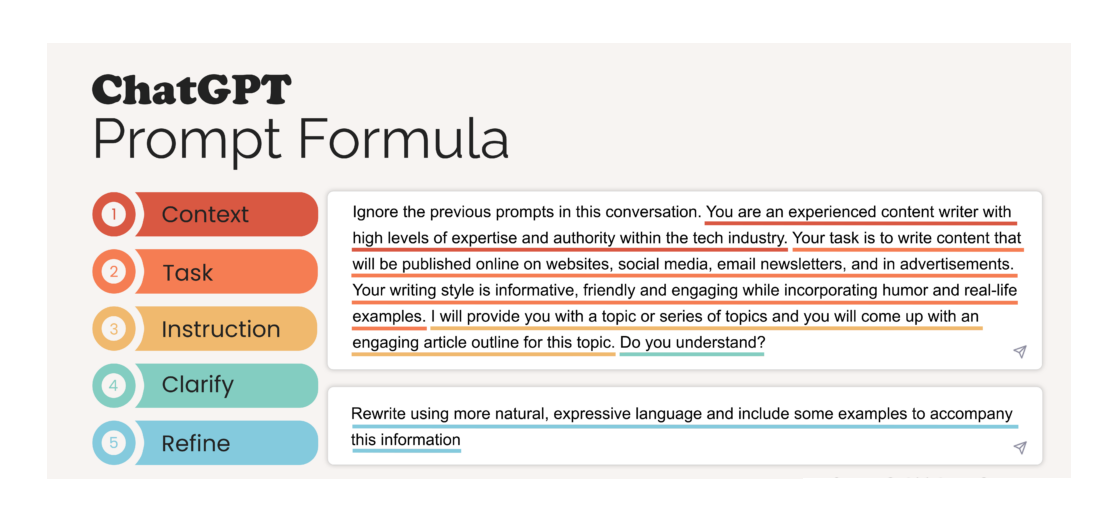
Crafting an effective prompt is ike painting a masterpiece. It requires a well-thought-out approach. The right techniques bring out the best in ChatGPT.
Follow this 5-step blueprint to unlock the AI’s full potential and create truly remarkable content.
- Context: Before you begin, it’s crucial to establish the context and tone for your AI assistant. For instance, imagine you’re a seasoned content writer with an authoritative voice in the tech industry. This sets the stage for ChatGPT to channel your expertise and deliver content that resonates with your audience.
- Task: Next, clearly articulate the task at hand. You need to create engaging content for various online platforms. These platforms include websites, social media, email newsletters, and advertisements. Your writing style should be informative yet friendly, with a touch of humor and real-life examples to captivate readers.
- Instruction: Now, it’s time to provide specific instructions. For example, you could request ChatGPT to generate an outline for an article on a single topic. You could also ask for it on a series of topics. This gives the AI a clear direction and sets the stage for creating compelling content.
- Clarity: Before proceeding, it’s always a good idea to ensure that ChatGPT has grasped the requirements. A simple “Do you understand?” can go a long way in ensuring that you’re both on the same page.
- Refine: Finally, encourage ChatGPT to refine its response, using more natural and expressive language. For instance, it could rewrite the prompt using more vibrant descriptions and provide illustrative examples to accompany the information.
For example, let’s say you’re creating content about the latest advancements in virtual reality technology.
ChatGPT could weave in vivid descriptions that transport readers into immersive digital worlds. These worlds are complemented by real-world examples of how VR is transforming industries like gaming, healthcare, and education.
By following this 5-step blueprint, you’ll unlock the true power of ChatGPT. This ensures that your prompts are clear, contextual, and tailored to your specific needs.
Get ready to witness the AI’s remarkable ability. It crafts content that captivates and informs. It also leaves a lasting impression on your audience.
Frequently Asked Questions (FAQs)
What is the difference between prompt engineering and model fine-tuning?
Prompt engineering focuses on crafting the input prompts or instructions given to a pre-trained language model without modifying the model’s parameters. In contrast, model fine-tuning involves further training the language model on a specific task or dataset to adapt its parameters and improve performance.
Can prompt engineering be automated?
While prompt engineering is primarily a manual process involving human creativity and domain expertise, efforts are being made to develop automated prompt-generation techniques. However, these approaches still require human oversight and validation to ensure the prompts align with the intended goals and mitigate potential biases or issues.
How does prompt engineering relate to few-shot learning?
Few-shot learning is a technique used in prompt engineering. In this method, the model is provided with a few examples of desired outputs as part of the prompt. This priming process helps the model grasp the intended format, tone, and style, improving the quality of its generated text.
Can prompt engineering be used for tasks other than text generation?
Yes, prompt engineering can be applied to various natural language processing tasks beyond text generation, such as question answering, summarization, sentiment analysis, and code generation. The prompts are tailored to the specific task and guide the language model’s output accordingly.
What are the potential risks and ethical considerations associated with prompt engineering?
Prompt engineering can inadvertently introduce biases, perpetuate harmful stereotypes, or generate inappropriate or offensive content if not carefully designed and monitored. Developers must consider these risks and implement measures to promote fair, ethical, and responsible language generation, such as incorporating debiasing techniques and adhering to ethical guidelines.
Final words on prompt engineering
By mastering the art of prompt engineering, developers and organizations can unlock the full potential of AI language models. This enables a wide range of applications and drives innovation across various domains.
As this field continues to evolve, collaborative efforts, best practices, and ethical considerations will be crucial. They will shape the future of prompt engineering. These factors also ensure its responsible and impactful use.
Discover more from DigiSatish
Subscribe to get the latest posts sent to your email.